Create, Suffer, and Love – Sermon Preached on 31st May 2026 (Trinity Sunday)

Preached at Christ Church, Bulkington (Benefice Service)

2 Corinthians 13.11-13; Matthew 28.16-20

“The grace of the Lord Jesus Christ, the love of God, and the communion of the Holy Spirit be with all of you.”

A large late-medieval brick town hall dominates the centre of the frame, its dark slate roof punctuated by small dormer windows and crowned by a tall square clock tower with a pointed spire. The tower displays a clock face and is decorated with red and white heraldic shields. Crenellated parapets run along the roofline, giving the building a fortress-like character. The façade features rows of arched and rectangular windows in warm red brick. A small statue on a pedestal stands in front of the building. The surrounding market square is busy with parked cars, a yellow delivery van, and a cyclist in a high-visibility jacket. To the right, a neighbouring building with an orange-tiled roof is partly visible. The sky is overcast and wintry, with bare trees to the left.
I was hoping for a few ales in Kalkar’s Rathauskeller, but it closes at 9 pm! © Gerry Lynch, 5 April 2018.

I was in Germany last week, which enjoyed the same heatwave as we did. I was therefore looking forward to exploring the pub culture as well as the much cheaper German pub prices. I arranged to meet someone I knew from social media but had never met in person, at 9.15 on a Wednesday evening. He lives in a town the size of Devizes, but he warned me that there wouldn’t be a pub open in that town for us to meet in. Instead we had to meet in the larger county town, about the size of Trowbridge, and even that wasn’t exactly lively.

And I know what you’re thinking – what on earth does this have to do with the Holy Trinity? Did the Rector get heatstroke, or perhaps have too much of the unholy sort of spirit when he was across the North Sea?

Well, let’s park that for a moment, and return to it once we’ve had a chance to talk about what it means to be human, and what it means to be God.

To create, to suffer, and to love – these are three of the deepest experiences that human life contains. Creating, suffering, and loving are central to making us human.

They are also central to what God is – God also creates, suffers, and loves.

Read more

St Aldegundis, Emmerich

St Aldegundis, Emmerich, North Elevation

Difficult to photograph close in due to its dense inner-city site, some say that St Aldegundis is on the site of the original mission church in what later became Emmerich am Rhein, founded by St Wilibrord around 700. That is debatable, but what is certain was there was a collegiate foundation in the town by 914 and that a church on this site burnt down in the early 15th Century. The current building was built to replace it between 1449 and 1514.

It has many lovely late medieval statues, photographed and described below…

Read more

What Is A Man? The Question Asked by a Memorial to Forgotten Wars

The memorial to the fallen of the 1860s Wars of German Unification in the Rheinpark in Emmerich (Kriegerdenkmal, Emmerich). Emmerich is a sleepy little river port on the Rhine, literally within a casual afternoon stroll of the Dutch border.


Emmericher Kriegerdenkmal.jpg

Completed under Wilhelm Kreis in 1913 on the eve of the First World War and deeply redolent of the ‘dulce et decorum est’ mentality which played such a role in that conflagration.

Upper text: “Der ist ein Mann, der sterben kann für Gott und Vaterland. EM Arndt.” – He is a man, who can die for God and fatherland.

Read more

St Nicolai, Kalkar

St Nicolai’s Church in the town of Kalkar (115km north of Cologne, 150km SE of Amsterdam) on the German Lower Rhine a wonderland of woodcarving from the late 15th and 16th Centuries, where a remarkable cast of woodcarvers found themselves with the patronage of wealthy religious brotherhoods. The most remarkable trio were Arndt van Zwolle, working at the end of the 15th Century, and later on Arnt van Tricht and Heinrich Douvermann.

I have not done this remarkable church justice: I needed both a tripod and time in this very dark building, neither of which I had. But I hope I will at least wet your appetite.

Kalkar 1

The story of St Nicolai’s probably began in 1230, but became really interesting after it was rebuilt after a devastating fire in 1409. The superstructure was substantially rebuilt into its current form by 1421, but it is the wonderful woodworking from the period around 1488-1560 that makes this perhaps the most celebrated church on the Lower Rhine.

The church has nine surviving woodcarved altars from a remarkable period of creativity between around 1488 and 1560. Five are at least partly visible in this shot. Nearest to camera are, left, the 1535 Trinity Altar, and, right, the 1541 St John’s Altar, both by the remarkable Arnt van Tricht. The central chandelier with the Virgin Mary took from 1508-41 to execute: van Tricht and Douverman were both among the artists who worked on this. The high altar dates to 1488-1500.

Kalkar 2

Arndt van Zwolle’s magnificent oak High Altar: begun in 1488, it was still incomplete at van Zwolle’s death, and finished by Jan van Halderen and Ludwig Juppe from 1498-1500. Worked in oak, it shows a multiplicity of scenes from the life of Christ crowned by the Calvary. There are a total of 208 figures carved. Behind it is the stained glass installed in the year 2000, the originals having been destroyed a long time in the passt. These were executed by Karl-Martin Hartmann, a physicist as well as an artist, using motifs like Feynman diagrams, galaxies, and spectroheliographs.

Read more

Boxing, Sculpture and ‘Degeneracy’: Joe Lewis, Max Schmeling and Rudolph Belling

Max Schmeling by Rudolph Belling

Bronze “Der Boxer Max Schmelling” by Rudolf Belling, 1928.

The divergent fates of sculptor and subject of this work are fascinating. Belling held radical views on the theory of sculpture, and his works were damned as ‘degenerate art’ (entartete Kunst) after the Nazis assumed power in 1933. He fled first to New York in 1935 and then to Istanbul two years later, where he would spend the next three decades. He had a successful academic career in Turkey, and moved back to Germany only as an eighty year-old in 1966.

Schmeling, World Heavyweight Champion from 1930-2, fought two legendary bouts against Joe Lewis. Given that Lewis was not only black, but perhaps the first African American to become a national icon, he represented another form of degeneracy for the Nazi régime and the fights had extraordinary political charge.

Read more

Statues of Kleve

Kleve, best known as the home of Anne of Cleves, is a county town in the German state of Northrhine-Westphalia, just 10 kilometres from the Dutch border, with a population of just under 50,000 – and an interesting collection of statues.
Statues of Kleve (6 of 8)

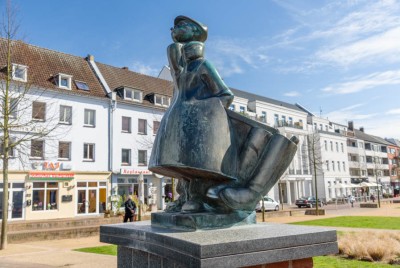
Officially called ’The Little Cobbler of Kleve’ (Klever Schüsterken), everyone calls this the Spitting Statue (Spuckmänneken) – for obvious reasons when the fountain is turned on. After the notorious Netherlands-West Germany 1990 World Cup quarter-final, local wags bedecked it in a Frank Rijkaard Dutch national team jersey! Again, officially, this 1951 statue by Joseph Brüx commemorates Kleve’s shoe industry – the city was long Germany’s capital of children’s shoes.

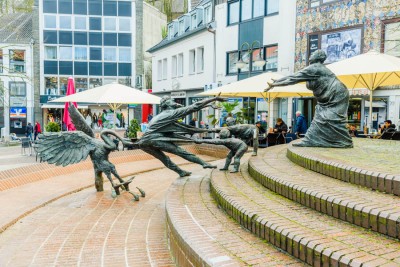
Statues of Kleve (1 of 8)Made by Karl-Henning Seemann in 1984-6, the Lohengrin Fountain statue in the heart of Kleve’s pedestrian precinct – informally called the Elsa Fountain – tells the story of Kleve’s mythical founder as related by Wagner.
Princess Beatrix lived in the Swan Castle just above the fountain around a thousand years ago. During a walk along the Rhine. she was approached by a Swan who wore a gold chain around its neck, pulling a boat on which a Knight stood, who told her he had come to defend her country. Beatrice fell in love with him and wanted to marry him. He said “yes” under one condition: that she never ask about his name or origin. The couple was happy and had three sons who, over time, became curious and tried to find out where their father came from. Eventually, Beatrix asked forbidden question to her Swan Knight. With a sad face he replied, “My name is Elias and I come from the earthly paradise”. Immediately the Swan appeared and then vanished with the Knight. Beatrice died a few months later of a broken heart.

The statue shows the Swan Knight’s sons desperately trying to stop him from being taken away, as Beatrice looks on helplessly.

Statues of Kleve (4 of 8)

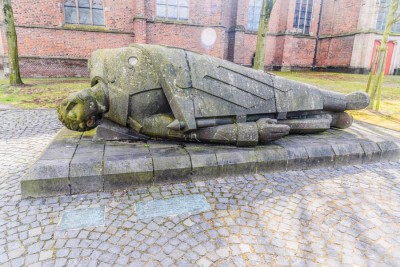
Right beside the Collegiate Church in Kleve, the Dead Warrior (Toter Krieger) statue by Ewald Mataré was erected as part of a World War One memorial originally in 1932. In 1938, it was removed and buried by the Nazis as so-called ‘degenerate art’: although perhaps in reality it was rather too honest an artistic statement about the consequences of industrialised total war for people who were about to start another one. In 1977, parts of the figure were accidentally discovered and it was restored and re-erected as a “warning against injustice and violence” in 1981. The biblical quote on the ground beside it is an extract from the First Letter of Peter – “Those who desire life avoid evil and do good: they seek peace and pursue it”.

Read more