
A baker’s dozen of the best shots I took while back home this month. All photos © Gerry Lynch.


A baker’s dozen of the best shots I took while back home this month. All photos © Gerry Lynch.

The Chapel of the Holy Spirit in Ripon Cathedral represents a sadly stillborn Anglican Space Age tradition of church furnishing. Completed in 1970 in honour of the previous year’s Apollo 11 moon landing, it is very much of its time.
I have seen some horrified reaction on social media to my photos of it, complaining at such a supposedly jarring presence in one of the finest buildings of the Romanesque-Gothic transition anywhere in Europe. Let us not forget, however, that the places of worship on this site have been substantially altered many times, including by St Wilfrid himself in the 7th Century, and even destroyed and completely rebuilt once. Perhaps most obviously, the Victorian restoration was imaginative but also far more inappropriate than this: yet Ripon Cathedral would not be what it is today without that and without a few fine pieces of Edwardiana and post-Edwardiana that are hardly redolent of the High Middle Ages.
Having long since passed through its groovy phase, to my mind the Chapel of the Holy Spirit has also by now finished its naff phase, and is becoming established as the sort of quirky period piece that any great cathedral must have many of from many different eras.
Located at the east end of the south choir aisle the chapel represents the Holy Trinity in themes astronomical and astronautical themes.

The hanging pyx represents Christ, who is sacramentally present within it, as this is where the Cathedral reserves the Blessed Sacrament.

The design of the pyx is essentially copied from the reaction control thrusters for the Apollo Lunar Excursion Module. Really, I’m not making that up.


St Pancratius (de Pancratiuskerk) in the little Dutch market town of ‘s-Heerenberg (population 8,000) and literally a ten minute stroll from the German border.
At first blush – another pretty, ornate, but unexceptional post-Vatican I church in the south eastern Netherlands, a sign of a long suppressed community bursting into both prosperity and political power. Inevitably designed by the Albert Tepe, a prolific architect of Dutch neogothic… and then…
In the north aisle a unusual piece of stained glass catches the eye – is that a Gestapo man in stained glass?

Yes, it is. And so one learns of the story of Frs. Galama and van Rooijen, parish priest and curate respectively, arrested in 1941 after preaching against the Dutch Nazi Party, the NSB, who were deported to Dachau where both died in 1942. The scene of the Judas kiss immediately above makes clear the bitter but rarely mentioned memories of collaboration and betrayal that must have haunted communities like this for decades after the war.
St Nicolai’s Church in the town of Kalkar (115km north of Cologne, 150km SE of Amsterdam) on the German Lower Rhine – a wonderland of woodcarving from the late 15th and 16th Centuries, where a remarkable cast of woodcarvers found themselves with the patronage of wealthy religious brotherhoods. The most remarkable trio were Arndt van Zwolle, working at the end of the 15th Century, and later on Arnt van Tricht and Heinrich Douvermann.
I have not done this remarkable church justice: I needed both a tripod and time in this very dark building, neither of which I had. But I hope I will at least wet your appetite.

The story of St Nicolai’s probably began in 1230, but became really interesting after it was rebuilt after a devastating fire in 1409. The superstructure was substantially rebuilt into its current form by 1421, but it is the wonderful woodworking from the period around 1488-1560 that makes this perhaps the most celebrated church on the Lower Rhine.
The church has nine surviving woodcarved altars from a remarkable period of creativity between around 1488 and 1560. Five are at least partly visible in this shot. Nearest to camera are, left, the 1535 Trinity Altar, and, right, the 1541 St John’s Altar, both by the remarkable Arnt van Tricht. The central chandelier with the Virgin Mary took from 1508-41 to execute: van Tricht and Douverman were both among the artists who worked on this. The high altar dates to 1488-1500.

Arndt van Zwolle’s magnificent oak High Altar: begun in 1488, it was still incomplete at van Zwolle’s death, and finished by Jan van Halderen and Ludwig Juppe from 1498-1500. Worked in oak, it shows a multiplicity of scenes from the life of Christ crowned by the Calvary. There are a total of 208 figures carved. Behind it is the stained glass installed in the year 2000, the originals having been destroyed a long time in the passt. These were executed by Karl-Martin Hartmann, a physicist as well as an artist, using motifs like Feynman diagrams, galaxies, and spectroheliographs.
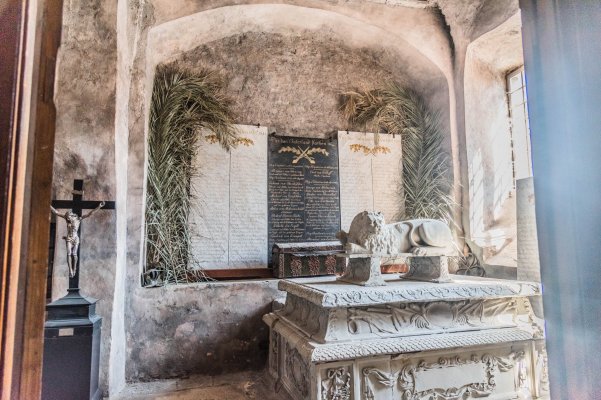
In the Toomkirik, Tallinn’s Lutheran Cathedral, this memorial to those who “für das Vaterland starben [died for the Fatherland], 1812-14”.
In the wars against Napoleon, the ‘Vaterland’ the German-speaking Protestant élite of Estonia died for was the Empire of the Tsars.
200 years ago, nationalism and the nation-state were concepts only beginning to emerge. Due loyalty was assumed to be to one’s sovereign, not one’s ethnic kinsman.