No sermon this Sunday or last Sunday as I’ve been on my summer holidays, in Kyrgyzstan. A lot of people asked me why I was going on holiday to Kyrgyzstan. I hope the photos below explain why!
Classic Kyrgyzstan scene, near Karakol.
Is the Skaza Canyon real life or a Star Trek scene?
Kyrgyz cowboy, near Karakol.
Last light on the Terskey Ala-toos, shot from the main road near Karakol.
The last days of 2022 saw me make my first visit to Dublin since 2013 and to Kilkenny since, I think, 1995! A trip to interview the delightful (and Most Rev’d) John Neill for my doctorate. I did a day trip from Belfast to Kilkenny by train, which I don’t particularly recommend giving the timings, … Read more
If you have seen television news reports from Kyiv, you will doubtless have seen the magnificent St Michael’s Golden-Domed Monastery. A huge trapezium of sky-blue with white vertical stripes, all capped by seven golden domes, and next to it an even bigger clock-tower in similar colours with a truly huge golden dome on top. It was originally built towards the end of the 11th Century, a few decades before our own St John’s, and like our St John’s it was developed in fits and starts over many centuries. It was hugely expanded in the ornate Ukrainian Baroque style which make Kyiv’s churches and monasteries a delight during the 18th Century, the period when many of our beautifully carved wall memorials in St John’s were erected.
What I’ll tell you next is hard to believe, although we have learned in recent weeks the depth of hatred Stalin held for Ukrainian culture and identity, but those wonderful 18th Century baroque extensions were used as an excuse for the Soviet authorities to declare the monastery historically “inauthentic” in 1934, and it was demolished, replaced by a modern office block housing the administrative headquarters of Soviet Ukraine. What we see today has been entirely rebuilt over the last thirty years, as faithfully as possible to what was there before.
On one level, buildings are just stones: but they are also things that can move people to tears through their beauty, and be the repositories of the soul of a nation, or a family, or a faith. Stalin, among others, understood how much buildings mattered – St Michael’s was one of thousands of churches destroyed across the Soviet Union in the 1930s, as the state tried to destroy Christianity. But he also understood the power of beautiful buildings to lift up and renew. Much of the centre of Kyiv was destroyed during the Second World War, and it was the site of one of the first rebuilding efforts in the immediate post-War years, especially around the famous Maidan, a handsome cityscape of optimistic wedding-cake towers and neo-classical pillars. The aim was to incarnate in stone the beauty of Communist ideals of progress and enlightenment, and inspire the people of Ukraine to play their part in rebuilding the USSR after the depredations of Hitler.
Let us turn the clock back even further, before the construction of St Michael’s in Kyiv and St John’s in Devizes, before even the times when Christ walked the earth, to the time when the Scythians were the people who dominated the great Eurasian plain, from Ukraine in the west as far as Mongolia in the east. A few years ago there was an exhibition of their art at the British Museum. The Scythians had no writing, but worked gold with exquisite skill, the equal of the Greeks and Persians of the same period. Complex depictions of Tree of Life, sometimes a foot high, reveal a people with a keen sense of spirituality and the wonder of creation. The instinct for beauty seems to be hard-wired into us.
The Chapel of the Holy Spirit in Ripon Cathedral represents a sadly stillborn Anglican Space Age tradition of church furnishing. Completed in 1970 in honour of the previous year’s Apollo 11 moon landing, it is very much of its time.
I have seen some horrified reaction on social media to my photos of it, complaining at such a supposedly jarring presence in one of the finest buildings of the Romanesque-Gothic transition anywhere in Europe. Let us not forget, however, that the places of worship on this site have been substantially altered many times, including by St Wilfrid himself in the 7th Century, and even destroyed and completely rebuilt once. Perhaps most obviously, the Victorian restoration was imaginative but also far more inappropriate than this: yet Ripon Cathedral would not be what it is today without that and without a few fine pieces of Edwardiana and post-Edwardiana that are hardly redolent of the High Middle Ages.
Having long since passed through its groovy phase, to my mind the Chapel of the Holy Spirit has also by now finished its naff phase, and is becoming established as the sort of quirky period piece that any great cathedral must have many of from many different eras.
Located at the east end of the south choir aisle the chapel represents the Holy Trinity in themes astronomical and astronautical themes.
The hanging pyx represents Christ, who is sacramentally present within it, as this is where the Cathedral reserves the Blessed Sacrament.
Public domain image used courtesy of Wikipedia – thanks.
Viewed here from the Paton Bridge is the enormous and ancient Pechersk Lavra monastery complex in the Ukrainian capital, Kyiv. This is the crucible in which East Slavic Orthodoxy was formed and is arguably the third most important religious community in the history Christendom behind only Monte Cassino and Mount Athos.
Kyiv Pechersk Lavra (Ukrainian: Києво-Печерська лавра; Russian: Киeво-Печерская лавра), also known as the Kiev Monastery of the Caves, was founded as a cave monastery in 1051, since which time it has usually been a preeminent centre of Orthodox Christianity in Eastern Europe. Together with the Saint Sophia Cathedral a few kilometres away, it is inscribed as a UNESCO World Heritage Site. Among others, the remains of Imperial Prime Minister Peter Stolypin, assassinated at the Opera in the city centre, lie at rest here.
While remaining a major cultural and tourist attraction, the monastery has been active again as a religious community since the 1980s, having been shut down by the Soviet authorities in 1928 and turned into a museum-park. Nowadays, there are now over 100 monks in residence.
Swakopmund always feels a little odd, like a piece of Germany somehow teleported into Namibia’s remote and thinly populated Atlantic Coast. Even in that context, the presence of the Marinedenkmal in the centre of town feels utterly weird.
The statue memorialises the German marines who died in the suppression of the uprising of the Herero and Nama peoples in what was then German South West Africa in 1904-5. Although the plaque states that they “Mit Gott für Kaiser und Reich Kämpften” (fought with God for Kaiser and Empire), it is widely accepted that the German suppression of the rebellion was the 20th Century’s first major genocide. German troops killed not only indigenous fighters, but non-combatant men, women and children in intentional acts of collective punishment. Others were driven into the desert to die of thirst and exposure, or simply allowed to die of exhaustion. Survivors of the massacre were put into forced labour camps. Around 50% of Nama and 80% of Herero died in the revolt and the three years of collective punishment which followed.
The mosque at Bohoniki is one of the last places of worship of the Lipka Tatar community which still survives as it has since the late 14th Century in what are now the borderlands Poland, Lithuania, and Belarus.
The mosque was built at the turn of the 19th and the 20th centuries, probably in 1873 to replace an earlier mosque destroyed in a fire. During World War II, the mosque was destroyed by the Nazis, who organised a field hospital on the site. After 1945, the mosque underwent several renovations several times. In 2003, the roof was renovated; the tin roof was changed to shingle roof. In 2005 a general renovation was carried out.
It is a simple wooden building built on a rectangular plan with dimensions of 11.49 m × 8.03 m. It has been restored with the help of the Polish and Turkish governments and the European Union.
This is the minbar, a pulpit in any mosque, where the imam stands to deliver sermons, as well as delivering a wider range of readings and prayers.
The Orthodox Cathedral of the Theotokos in Vilnius. Originally built by architects from Kievan Rus’ in 1346-8, commissioned by Grand Duke Algirdas for his Orthodox wife, Uliana of Tver. From 1609, it was used by Eastern Rite Catholics until it was abandoned after a major fire in 1748. It was reconstructed in 1785 only be … Read more
The Cathedral Basilica of St Stanislaus and St Ladislaus of Vilnius (Lithuanian: Vilniaus Šv. Stanislovo ir Šv. Vladislovo arkikatedra bazilika) is the Roman Catholic mother church of Lithuania. The coronations of the Grand Dukes of Lithuania took place within its confines. Many famous people from Lithuanian and Polish history are buried there During the … Read more


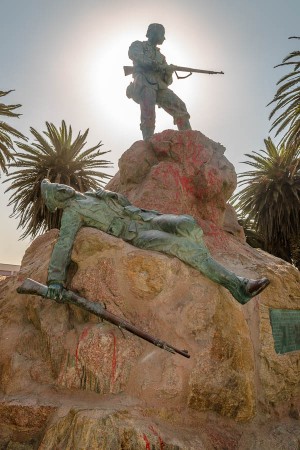 Swakopmund always feels a little odd, like a piece of Germany somehow teleported into Namibia’s remote and thinly populated Atlantic Coast. Even in that context, the presence of the Marinedenkmal in the centre of town feels utterly weird.
 The mosque at Bohoniki is one of the last places of worship of the