The Opioids of the People

Crossposted at Slugger O’Toole…

The United States government has launched a new anti-opioid campaign featuring true stories of people so desperate that they inflicted gruesome injuries on themselves to get another prescription.

Such stories have already been more effectively told in poetry. The epidemic’s most searing skald is William Brewer, a son of Oceana, West Virginia, a post-industrial town so gripped by addiction that it is nicknamed Oxyana.

We were so hungry; Tom’s hand
on the table looked like warm bread.
I crushed it with a hammer
then walked him to the ER to score pills.

The United States has now experienced its second consecutive year of declining life expectancy. A significant part of the change is driven by what have been called ‘deaths of despair’ among middle aged White people: as well as drugs, alcohol and suicide are also spiralling. Death rates among White Americans aged 45-54 increased by 0.5% per year between 1999 and 2013, and there is no sign the trend has reversed since. While the death of celebrity chef Anthony Bourdain this weekhas brought fresh awareness of suicide, rates have been rising for years, especially among middle-aged men, and are now 25% higher than they were at the turn of the millennium.

Read more

Presbyterians, Salvation, and God

Cross-posted at Slugger O’Toole.

We cremated my friend James on the freakishly warm Friday before St Patrick’s Day, between the two bouts of even freakier snow. We did this after a celebration of the Supper of the Lord Jesus Christ who was his Saviour and the anchor of his life. The daffodils bobbed in the sunshine as we took his coffin through the traffic from the church in the shadow of St Paul’s Cathedral to the crematorium in East Finchley, his terminus ad quem before his voyage to heaven. As an Angus-born and Edinburgh-reared son of the Kirk, he came to mind after this week’s shenanigans at the Presbyterian General Assembly in Belfast.

James lived with MS for thirty years, something unimaginable when he was first diagnosed in the late 1980s. His continued life was a miracle, but it was also a struggle. I never knew the wordsmith, cyclist and cook that his older friends wrote about (movingly here and here). By the time I met him, sixteen years ago, his disease had robbed his legs of the power to walk, left his hands unable to handle a pen or a carving knife, and made his speech slurred and slow.

What he was never robbed of was his indomitable spirit, his twinkly smiling eyes, or his dry humour. Nor did MS prevent him throwing the legendary champagne-soaked parties in his Barbican flat, attended by a mix of characters who had little in common but their friendship with this delightful bon vivant: nonagenarian grand dames from Islington garden square mansions would rub shoulders with middle-aged actors struggling long past any hope of stardom and recently arrived twenty-somethings from Doncaster or Brazil, penniless but sure they’d make their fortune in London.

I never heard him complain about his lot: at most he would sigh wistfully that people should avoid getting MS if they could, not that they can. In that I saw a shadow of the boy, many decades before, whose father died when he was only nine, who then had to grow into a man far too soon and just get on with it.

Read more

St Nicolai, Kalkar

St Nicolai’s Church in the town of Kalkar (115km north of Cologne, 150km SE of Amsterdam) on the German Lower Rhine a wonderland of woodcarving from the late 15th and 16th Centuries, where a remarkable cast of woodcarvers found themselves with the patronage of wealthy religious brotherhoods. The most remarkable trio were Arndt van Zwolle, working at the end of the 15th Century, and later on Arnt van Tricht and Heinrich Douvermann.

I have not done this remarkable church justice: I needed both a tripod and time in this very dark building, neither of which I had. But I hope I will at least wet your appetite.

Kalkar 1

The story of St Nicolai’s probably began in 1230, but became really interesting after it was rebuilt after a devastating fire in 1409. The superstructure was substantially rebuilt into its current form by 1421, but it is the wonderful woodworking from the period around 1488-1560 that makes this perhaps the most celebrated church on the Lower Rhine.

The church has nine surviving woodcarved altars from a remarkable period of creativity between around 1488 and 1560. Five are at least partly visible in this shot. Nearest to camera are, left, the 1535 Trinity Altar, and, right, the 1541 St John’s Altar, both by the remarkable Arnt van Tricht. The central chandelier with the Virgin Mary took from 1508-41 to execute: van Tricht and Douverman were both among the artists who worked on this. The high altar dates to 1488-1500.

Kalkar 2

Arndt van Zwolle’s magnificent oak High Altar: begun in 1488, it was still incomplete at van Zwolle’s death, and finished by Jan van Halderen and Ludwig Juppe from 1498-1500. Worked in oak, it shows a multiplicity of scenes from the life of Christ crowned by the Calvary. There are a total of 208 figures carved. Behind it is the stained glass installed in the year 2000, the originals having been destroyed a long time in the passt. These were executed by Karl-Martin Hartmann, a physicist as well as an artist, using motifs like Feynman diagrams, galaxies, and spectroheliographs.

Read more

A Tallinn Memorial from the Days before Nationalism

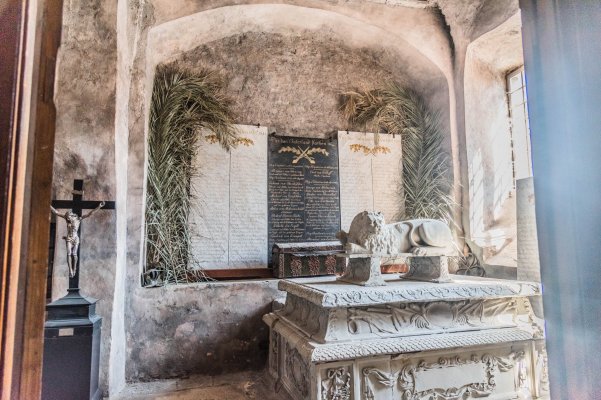
Tallinn Memorial

In the Toomkirik, Tallinn’s Lutheran Cathedral, this memorial to those who “für das Vaterland starben [died for the Fatherland], 1812-14”.

In the wars against Napoleon, the ‘Vaterland’ the German-speaking Protestant élite of Estonia died for was the Empire of the Tsars.

200 years ago, nationalism and the nation-state were concepts only beginning to emerge. Due loyalty was assumed to be to one’s sovereign, not one’s ethnic kinsman.

Read more

Mariken van Nieumeghen aka Little Mary of Nijmegen

Stevenskerk-18.jpg

This bronze statue has been on Nijmegen’s Grote Markt, by the entrance to the Stevenskerk, since 1956 and was executed by Vera Tummers-Van Hasselt. It represents Mariken van Nieumeghen (Little Mary of Nijmegen) one of the symbols of the city in one of the best loved pieces of medieval Dutch literature.

According to a miracle play probably written between 1485 and 1510 in Antwerp, Mariken lived with the devil for seven years. Mariken had to go into town to do some shopping for her uncle. By the time she finished, it was already too late to go home, and she was not welcome to stay with her aunt in the city.

Wandering through the countryside, she met the Devil, who presents himself as Moenen. Moenen persuaded Mariken to accompany him to Antwerp. There, they led a very dissolute life for years. But Mariken wanted to see her family again. Together Mariken and Moenen returned to Nijmegen. Once there, Mariken sees a pageant, which demonstrates that everyone can receive forgiveness from God for their sins, which brings Mariken to repentance.

Read more