A Vision for the Appointed Time: Sermon Preached at St John’s, Devizes, Sunday 3rd July 2022 (Feast of St Thomas)

Readings – Habbakuk 2: 1–4; John 20: 24–29

“…there is a vision for the appointed time.”

It hasn’t been much of a summer, has it? Even by Wimbledon fortnight standards, we have had a depressingly heavy dose of rain. We are promised rather better for the next fortnight, and the wet start to the summer means we shall appreciate it all the more if we are indeed blessed with a fine spell in the next few weeks, when the days are still at their longest.

A carpet of flowers in the Namaqualand desert around a water-pumping mill.
The desert blooms briefly in South Africa’s Namaqualand region as winter ends. © Gerry Lynch 27 August 2011

On the other side of the world it isn’t high summer, but the depths of winter. In August, when winter starts to give way to springtime, something remarkable happens in the deserts that straddle the border between South Africa and Namibia. Normally almost completely barren, for a few weeks the desert blooms with carpets of flowers, sometimes stretching for miles in brilliant purples, oranges, and bright yellows, all giving off the most wonderful perfume. It is as if heaven has suddenly broken into the mundane world.

The same thing happens in a few other spots around the world as winter ends, where a desert approaches a western ocean coast and the rainfall patterns are favourable – in parts of Chile and California and Western Australia. The barren desert blooms with billions of wild flowers, and it comes and goes in a few weeks, and then the barrenness returns.

There is a vision for the appointed time… wait for it.

This is one of the more pessimistic times any of us have lived through. The desert has plenty of charms and compensations compared with the barren dryness of our culture and our political discourse.

It is not, despite all that, a time that quite matches the mood of hysterical doom-mongering that dominates our media reporting and especially our online discussions. I remember the 1980s, which were at least as politically divided as the current era, and also a time which in this country and generally in Western Europe was marked by much more politically-motivated violence than today, both in terms of terrorism and of street fighting. Most of it is now forgotten. The threat of war with Russia was quite a bit more intense then, with TV shows like Threads depicting the likely consequences of a nuclear war for ordinary people in grizzly detail. We also had a thousand miles of fortifications through the middle of Europe with easterners routinely shot dead by their own governments for trying to cross them. I am not going to join the panic-mongers just yet about our own situation, even if the United States seems to be in the grip of collective insanity.

Read more

Afghanistan Exposes the West’s Crisis as it did the Soviets’

This post originally appeared on Slugger O’Toole

The Soviet Empire was undone by three things – firstly, overstretching itself, especially through the acquisition of a series of Global South satrapies from Nicaragua through Ethiopia to Vietnam in the 1970s and 1980s; secondly, misrepresenting realities to itself so as to fit Marxist-Leninist orthodoxy; thirdly, because its leaders no longer believed in that political religion even as they presided over a system that permitted no alternative.

Mohammad Najibullah’s government hung on in Kabul for three years after Soviet troops were withdrawn from Afghanistan in 1989; Ashraf Ghani’s kleptostate didn’t even survive until America’s withdrawal date. US and other Western experts were more wrong about Afghan society than the famously self-deluding late Soviet Union; in terms of plain logistics, the US executed a shockingly less competent withdrawal than a USSR on the brink of collapse; and in the shape of Ghani and before him Karzai, it backed rulers so monumentally corrupt that they seem to have been less palatable to devout Afghan Muslims than actual godless Communists.

In the dying days of 1979, Yuri Andropov, then head of the KGB, fought an initially successful internal battle against Soviet intervention in the country after the Communist coup, convinced that invading Afghanistan would end up in failure; it was feuding between Afghan Communist factions once in power that dragged the USSR in, and fear of losing face in the propaganda game of the late Cold War that kept it there for a while. But it only took the Soviets seven years to realise they weren’t actually being welcomed as defenders of material progress and women’s rights against religious obscurantism, and they were gone in nine. America took twenty.

Soviet APCs depart Afghanistan as part of the first phase of troop withdrawal in 1986.
Soviet APCs depart Afghanistan as part of the first phase of troop withdrawal in 1986. © RIA Novosti archive/ Yuriy Somov. Used under CC-BY-SA 3.0.

Yet all the while, the people directing the war in DC knew it was going badly and simply lied, as the Washington Post exposed in 2019 when it got access to the US government’s own report on its failures in Afghanistan. The Bush, Obama, and Trump administrations all lied, knowingly, not just to the public but much of the time to themselves; they couldn’t have sustained this war for 20 years otherwise. Countless experts colluded in the lies, spending time and money to create analyses to fit a consciously deceitful official narrative, nodding along because dissenting voices find their careers limited while nodding dogs get to bill four-figure daily rates.

Governments lying to themselves with the encouragement of experts well-paid to silence truth-tellers is a pattern of behaviour familiar from the story of toxic mortgage bonds and the 2008 financial crisis; something similar will probably turn out to surround the pandemic’s origins and how influential Western medics helped Beijing cover them up. This is not just an American problem. Lying is just as embedded, for example, in the UK, where the political class and punditocracy spent yesterday arguing about the ways in which Britain could have saved Kabul from the Taliban when the same people know British combat troops left Afghanistan in 2014.

Truth is now entirely subject to political ideology in the West, but being liberal democracies rather than a single-ideology state, various nexuses of deceit sell different sets of lies to their own groups of followers. The progressive/left take is that jihadism only exists because of colonialism and White supremacy with British Labour MP Richard Burgon even demanding reparations be paid to the Taliban. The soi disant sensible centre-left-to-mainstream-right were the actual architects of the Afghan disaster, with neocons and hawkish liberals like Blair inventing for themselves an Islamic world crying out to be bombed from the air so they could be free. And, of course, the post-Trump GOP is so far down the rabbit-hole of QAnon-lizardmen-paedo-pizza conspiracy that it doesn’t worry that its lies sound like they come from the secure wing of the local asylum.

Read more

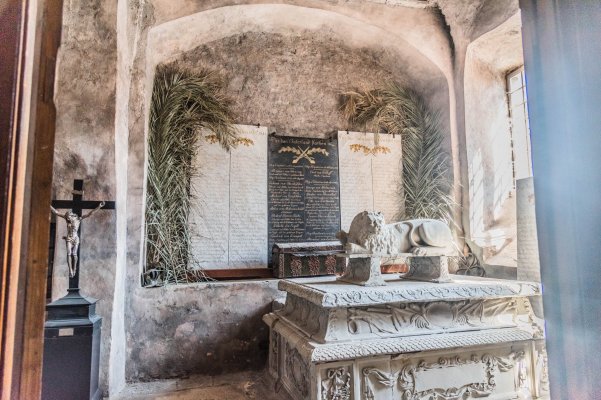
A Tallinn Memorial from the Days before Nationalism

Tallinn Memorial

In the Toomkirik, Tallinn’s Lutheran Cathedral, this memorial to those who “für das Vaterland starben [died for the Fatherland], 1812-14”.

In the wars against Napoleon, the ‘Vaterland’ the German-speaking Protestant élite of Estonia died for was the Empire of the Tsars.

200 years ago, nationalism and the nation-state were concepts only beginning to emerge. Due loyalty was assumed to be to one’s sovereign, not one’s ethnic kinsman.

Read more