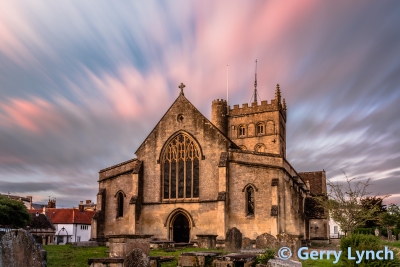
Sermon Preached at St John’s Devizes on Sunday 19 July 2020, the 6th Sunday After Trinity

Readings – Romans 8:12–25, Matthew 13:24–30, 36–43

“…in gathering the weeds you would uproot the wheat along with them. Let both of them grow together until the harvest.”

May I speak in the name of God, who is Father, Son, and Holy Spirit. Amen.

It is good to be with you as your curate for the first time this morning. And I hope, for all of you, it is good to be back in Church.
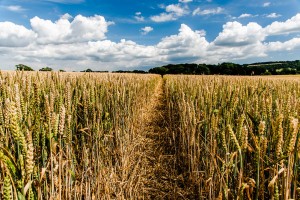
Wiltshire Wheat Fields in mid-July near West Dean © Gerry Lynch
Wiltshire wheat fields in mid-July, © Gerry Lynch, 22 July 2016.

The parable of the wheat and the weeds centres on the idea that God allows both goodness and wickedness to flourish here on earth. It is particularly appropriate at this time, for we’ve seen the best and the worst of human nature over the four months since people last gathered together to pray here in St John’s. We’ve seen medical personnel and care home staff put their lives on the line, and in some cases give their lives, for the common good. We’ve seen the natural world revive as the pressure we human beings put on it eases off just a little, with cleaner air and water, less noise, and wildlife returning to our towns and cities. We’ve seen a great revival of community spirit, with neighbours looking out for the vulnerable, and we’ve also seen a great global effort of medical science taking place across boundaries of nation, religion, race, and system of government.

We’ve also learned a lot about who is genuinely indispensable to society: when most of us were told to stay at home if we possibly could, those who still had to go into work were often those least financially rewarded for their labours. Supermarket workers, staff in meat plants, fruit and vegetable pickers, truck drivers, security guards, home helps, taxi drivers, as well as those working in the NHS and care homes – these were the people who had to go to work right through the worst of the pandemic, and many of them earn wages that make it impossible for them to imagine providing a secure home for their families. These were the people who died in disproportionate numbers.

Read more

Twilight View of the Kyiv Pechersk-Lavra Monastery Complex

The Kyiv Pechersk Lavra monastery complex shot from the Paton Bridge in a golden evening twilight, 9 August 2018
Kyiv Pechersk-Lavra Complex shot from the Paton Bridge, 9 August 2017, © Gerry Lynch.

Viewed here from the Paton Bridge is the enormous and ancient Pechersk Lavra monastery complex in the Ukrainian capital, Kyiv. This is the crucible in which East Slavic Orthodoxy was formed and is arguably the third most important religious community in the history Christendom behind only Monte Cassino and Mount Athos.

Kyiv Pechersk Lavra (Ukrainian: Києво-Печерська лавра; Russian: Киeво-Печерская лавра), also known as the Kiev Monastery of the Caves, was founded as a cave monastery in 1051, since which time it has usually been a preeminent centre of Orthodox Christianity in Eastern Europe. Together with the Saint Sophia Cathedral a few kilometres away, it is inscribed as a UNESCO World Heritage Site. Among others, the remains of Imperial Prime Minister Peter Stolypin, assassinated at the Opera in the city centre, lie at rest here.

While remaining a major cultural and tourist attraction, the monastery has been active again as a religious community since the 1980s, having been shut down by the Soviet authorities in 1928 and turned into a museum-park. Nowadays, there are now over 100 monks in residence.

Read more

The Case for Socialist Healthcare in One Country

“If China and Covid can’t shake doctrinal globalism, can anything?” My latest piece in The Critic… My friend Murat runs two tailor’s shops in the south of England. Having arrived from Turkey as a sole trader five years ago running a little alteration business in Salisbury, he now employs eight people, has a second premises … Read more

Beginning Public Ministry in a Liminal Time

St Anne's Cathedral, Belfast, reflected in a puddle on Donegall Street, 29 April 2020, © Gerry Lynch

On Saturday last, I should have made a deacon in Salisbury Cathedral, a place I love, the antepenultimate milestone in a journey to fulfil a call to priesthood in the church of God that I began, depending on how one counts it, either six, ten, or twenty-two years ago. I first went to see the Director of Ordinands for the Diocese of Connor and joined the Fellowship of Vocation there in September 1998. I often find it useful to date moments in my life by the pop songs on the radio at the time; the UK Number 1 single then was, with delicious irony, T-Spoon’s Sex on the Beach. That really was a long time ago now.

St John the Baptist Church, Devizes, 1 July 2020, © Gerry Lynch

Having been formally licensed as a lay worker in the parish of St John with St Mary, Devizes, by the Bishop of Salisbury via videoconference on Sunday I am, however, a curate if not a cleric, an officially licensed tender of God’s garden of souls at a time when churches have not held public worship for more than three months, when public health regulations have quite correctly banned visiting the army of lonely and isolated people in their own homes. Hundreds of others have had their ordinations similarly delayed, and are experiencing similar uncertainties. For me, a journey towards ordained ministry that often involved being told that I was an awkward person on the edge leads to a public ministry that begins in a virus-ravaged world that sits on the edge of… who knows what?

Wikipedia tells me that in anthropology, liminality (from the Latin word limen, meaning ‘a threshold’) is the quality of ambiguity or disorientation that occurs in the middle stage of a rite of passage, when participants no longer hold their pre-ritual status but have not yet begun the transition to the status they will hold when the rite is complete. Liminality is terribly fashionable in the Church at the moment; I have not always found it to be a pleasant or rewarding place to inhabit. It is, however, the state in which the whole world waits for a new order to emerge, groaning for better but often in trepidation of worse.

Liminal time exists in the cracks in our lives and the cracks in the life of the world that lie between the passing of the old and the coming of the new. Of course, there are other ways of looking at the world, ways that emphasize the continuities rather than the discontinuities. Emphasising the continuities that lie across all breaks in human experience seems to have been the most modish approach of late. Understandings that emphasize continuity bring richness and insight, for each of us always remains himself and all of us always remain human. Like all perspectives, however, these are limited. Just as a photographer will choose his perspective depending on the time of day and year, weather conditions, subject matter, and the like, sometimes we must consciously open ourselves to new viewpoints on ourselves and our world.

Read more