“Rebuild my Church”: Sermon Preached at St John’s Devizes on Sunday 4 October 2020 (the 17th Sunday After Trinity) by Gerry Lynch

Readings – Philippians 3:4b-14, Matthew 21:33-46

I press on towards the goal for the prize of the heavenly call of God in Christ Jesus.

May I speak in the name of God, who is Father, Son, and Holy Spirit. Amen.
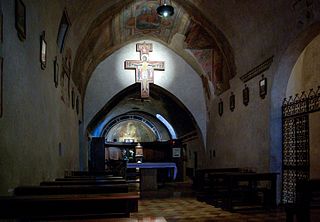
The Church of St Damian, Assisi. Photo credit Berthold Werner.

It is a time of troubles. Plagues, accelerated by the rapid growth in intercontinental trade, spread across the world with dizzying speed. The economic gap between rich and poor is yawning, and many of the young have given up on the ability of the existing order to usher in a just society and are seeking a completely fresh start, consigning the old ways to the dustbin of history with as much aggression as needed. The West and the Islamic world are at loggerheads, with Western powers embroiled in multiple bloody conflicts in the Middle East, which started so long ago that nobody much remembers how or why they started. I am not, of course, talking about the present day but about the first years of the 13th Century, a time when the older townsfolk of Devizes will still have remembered the Church of St John the Baptist being built. There is truly nothing new under the Sun. 

In that tumultuous time, a rich young party animal called Francis, whose feast we commemorate today, was having a life crisis. Set to inherit a family fortune, he had spent his youth hanging out with the troubadours, the wandering bands of minstrels who travelled around during the High Middle Ages making music, singing with them in his beautiful voice and partying with them. An attempt to settle down a little by turning his hand to soldiering had resulted in Francis spending a year as a prisoner of war. After that, his former life of drinking and dancing no longer had any appeal. He wandered the countryside of his native central Italy, half-starved and dressed in rags, begging God to show him a more meaningful way of life. One day, Francis stumbled across a church dedicated to Saint Damian, no older than the then relatively new St John’s, but already falling into disrepair. Amid the crumbling stones, he had a vision of an Icon of Christ Crucified that hung in the church speaking to him. “Rebuild my Church”, it said.

He took up the task with enthusiasm, starting with the physical rebuilding of that Church of St Damian, and going on to work for a spiritual renovation of the whole Christian world. Some of his schemes were perhaps a little overambitious: he once travelled to Cairo, reckoning that if he could only convert the Sultan to Christianity then he could end the wars connected to the Crusades. You will not be surprised to learn that he wasn’t successful.

But that isn’t the point – the point is that he gave things a go. Following Christ isn’t about following a series of step-by-step orders like the instructions for setting up a new mobile phone. As we know, that doesn’t guarantee success anyway. Richard Holloway once described the Christian journey as being less like marching to a heavenly military band and more like joining God in a jazz jam session, listening to the music God is playing and seeking to chime our own personal riffs with His. Christian obedience is about co-operating with God and recognising our own immense value to Him. God is not a cosmic sergeant-major waiting to scream at us angrily if we miss a beat. If God doesn’t pick up on the tune we’re playing, we can always get back into the beat in the next bar. New life can begin at any time. Following Christ is about trying to sense where the Holy Spirit is leading, trying different ideas, accepting that God will not pick up on some of them, because it’s only in a world of chance and risk and serendipity that other little tunes we toot can blossom into symphonies that are more magnificent than anything we could have imagined.

Read more

Get Thee Behind Me Satan – Sermon on 30th August 2020 (Twelfth Sunday After Trinity)

Preached at St John’s, Devizes

Readings – Romans 12:9-21, Matthew 16:21-28

But he turned and said to Peter, ‘Get behind me, Satan! You are a stumbling-block to me; for you are setting your mind not on divine things but on human things.’

May I speak in the name of God who is Father, Son, and Holy Spirit.

Der Baader Meinhof ComplexLast week I watched two films that depicted how people convinced they are fighting injustice can descend into barbarism precisely because of their moral certainty. Both looked back on events in the late 1960s and 1970s. The first was Sam Green and Bill Siegel’s insightful documentary on The Weather Underground, the second was Bernd Eichlinger’s emotionally overwhelming dramatization of the story of The Baader Meinhof Complex. On both sides of the Atlantic, young people outraged by the nightly television scenes from Vietnam, with America killing civilians in great numbers, themselves resorted to bombing and killing. None of this produced any of the justice and liberation they sought. In the end, both organisations found the world moved on rapidly and left those in them behind: on the run, or marooned on the edge of society, or imprisoned. The illusion that if only we ourselves ran the world, then everything would be wonderful, is a dangerous one.
First century Palestine was a place of political and religious ferment and frequent outbreaks of religiously-inflected political violence. Utopianism was as prevalent there as it was in the Chicago or West Berlin of 1968. To understand how Jesus calling Peter “Satan” fits into that world, we need to go back to the episode in Matthew’s Gospel that immediately precedes Jesus beginning his public ministry. It’s the bit where Jesus is “led up by the Spirit into the wilderness to be tempted by the devil”. The last of the three temptations Satan puts before Jesus is to offer him all the kingdoms of the world in return for His worship. Jesus refuses and the Devil flees. Jesus’ goal is not power or conquest, nor even to initiate an enlightened political order, but the service of His heavenly Father.

Peter stumbles into being a bit of a devil without realising it, for he places exactly the same temptation before Jesus, to renounce His mission from the Father and seize earthly power. We know that power comes into it for the passage immediately preceding this, the Gospel at last Sunday’s service, is the one where Peter is the first person to correctly identify Jesus as the Messiah. The Messiah was expected to be an extraordinary God-sent leader who would restore The Temple to holiness from the way it had been spiritually despoiled by the Herods, and deliver the Jewish people from Roman Occupation. It was thought the Messiah was going to, if you will, Make Jerusalem Great Again.

Read more

Sermon Preached at St John’s Devizes on Sunday 19 July 2020, the 6th Sunday After Trinity

Readings – Romans 8:12–25, Matthew 13:24–30, 36–43

“…in gathering the weeds you would uproot the wheat along with them. Let both of them grow together until the harvest.”

May I speak in the name of God, who is Father, Son, and Holy Spirit. Amen.

It is good to be with you as your curate for the first time this morning. And I hope, for all of you, it is good to be back in Church.

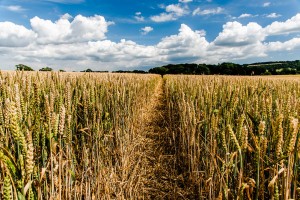
Wiltshire Wheat Fields in mid-July near West Dean © Gerry Lynch
Wiltshire wheat fields in mid-July, © Gerry Lynch, 22 July 2016.

The parable of the wheat and the weeds centres on the idea that God allows both goodness and wickedness to flourish here on earth. It is particularly appropriate at this time, for we’ve seen the best and the worst of human nature over the four months since people last gathered together to pray here in St John’s. We’ve seen medical personnel and care home staff put their lives on the line, and in some cases give their lives, for the common good. We’ve seen the natural world revive as the pressure we human beings put on it eases off just a little, with cleaner air and water, less noise, and wildlife returning to our towns and cities. We’ve seen a great revival of community spirit, with neighbours looking out for the vulnerable, and we’ve also seen a great global effort of medical science taking place across boundaries of nation, religion, race, and system of government.

We’ve also learned a lot about who is genuinely indispensable to society: when most of us were told to stay at home if we possibly could, those who still had to go into work were often those least financially rewarded for their labours. Supermarket workers, staff in meat plants, fruit and vegetable pickers, truck drivers, security guards, home helps, taxi drivers, as well as those working in the NHS and care homes – these were the people who had to go to work right through the worst of the pandemic, and many of them earn wages that make it impossible for them to imagine providing a secure home for their families. These were the people who died in disproportionate numbers.

Read more

Chapel Address at Evensong, St Stephen’s House, Oxford, 4 November 2019

Chapel Address at Evensong, St Stephen’s House, Oxford, 4 November 2019
Gerry Lynch

St Stephen's House Chapel, Oxford

“When you talk to God, it’s called prayer. When God talks to you, it’s called insanity.”

That bon mot came to mind as I pondered today’s readings from the first chapters of Daniel and Revelation, two of the most misunderstood and misused books of the Bible, yet also among the most transcendent.

Prophecy has always been a tricky topic in the Church – St Paul admonished the Corinthian Church about it. The soldiers who beat up the blindfolded Jesus demanded he guess which of them had struck him. They were confusing prophecy and fortune-telling. It is still a common mistake, and made as much within the Church, or at last at its fringes, as it is outside it. The YouTube fanatics who drop random texts from Revelation to confidently predict the arrival of doomsday next Wednesday have done tremendous damage to the Church.

The Belfast of my boyhood was thick with these chancers. There was even a BBC children’s TV drama of the early 1980s, set in Belfast, about one of these street corner Jeremiahs, entitled The End of the World Man. Of course the title character was nothing but a hypocrite, setting himself up in self-righteous judgement while using his political connections to facilitate a corrupt land deal to destroy a patch of urban wilderness much loved by our televisual child heroes. If you want to lampoon the Church, these self-proclaimed prophets are an easy way to do it. And they are terribly unbiblical. The end will come like a thief in the night; it is not ours to know when and how it will come; Jesus says this very directly in St Matthew’s Gospel.

Read more

Sermon Preached at St Mary Magdalen, Oxford, 3 November 2019

Sermon Preached at Sung Mass at St Mary Magdalen, Oxford, 3 November 2019 (All Saints’ Day transferred)                                                               Gerry Lynch

St Mary Magdalen, Oxford (C) Gerry Lynch.jpg

After this I looked, and behold, a great multitude which no man could number, from every nation, from all tribes and peoples and tongues, standing before the throne and before the Lamb. (Revelation 7:9)

In the name of the Father, and of the Son, and of the Holy Spirit.

That was a great hymn we started with this morning, wasn’t it, For All The Saints? And there’s more to come later. All the same, the hymn that I’ve always found most appropriate for this season of All Saintstide isn’t in the hymnbook used in this church, the New English Hymnal. At the moment, the New English Hymnal is being revised and I hope they might make space for my favourite All Saintstide hymn in the revision. Can you guess what it is? You’ll all know it. It’s the one that goes:

Oh, when the saints!
Oh, when the saints come marching in!
I want to be in that number, when the saints come marching in!
[Yes, I did break into song from the pulpit… and even had a wee dance.]

Now, the reason for that – that performance – from the trainee preacher from vicar school was to ask you all a question: do you want to be in that number when the saints come marching in? Do you think you have it in you to become a saint? Is saintliness something that we should aspire to? Or does sainthood instead represent an impossibly high standard, and the attempt to achieve it leave us doomed to failure at best, and at worst arrogantly claiming to be far better than we could possibly be, smugly looking down on the rest of humanity from a pedestal so high that it gives everyone else a clear view of our many and obvious faults?

Read more

Sermon Preached at St James’ Church Alderholt on Sunday 3 May 2015 (Easter 5)

Readings – John 15:1-8; Acts 8:26-40.

Pruning doesn’t seem like a very pleasant process for whomever is being pruned. It carries connotations of being taken down to size, perhaps of having one’s wings clipped. Christ says in today’s Gospel that abiding in Him, and bearing fruit for the Father, means that at times we’ll have to undergo the process of being cut back. It’s right here in one of the most loved passages of Scripture.

Currently in the Church, it can also be an idea that is pushed to one side, replaced by a forced confidence that “good” vicars and “faithful” parishioners will have “growing” churches that run a whole range of social projects which never go wrong. They not only feed the hungry and clothe the naked, but get them signing up to adult baptism courses as well.

We shove out of the way the idea that we are a vine that sometimes needs pruned, perhaps because it brings into the open a difficult reality: that following Christ is often painful. It is emotionally painful – for trying to love our enemies or forgive those who have wronged us always hurts, and is so difficult that it often ends in the second hurt of failure. Truly following Christ is often financially painful, or painful in the way that it shatters our ego and self-delusion, and it can be physically painful. As we meet here in peace to celebrate the feast, somewhere in the world, someone is being put to death for their faith in Christ.

Read more