Paying the Rent – Sermon Preached on 4th October 2026 (Eighteenth Sunday after Trinity)

Preached at Christ Church, Worton; Holy Cross, Seend; and Christ Church, Bulkington

Philippians 3.4b-14; Matthew 21.33-46

“…the kingdom of God will be taken away from you and given to a people that produces the fruits of the kingdom.”

A fresco of a crowd in a town square. On the right, a bishop wraps his cloak around a nearly naked young man, who raises his hands towards a hand appearing from the sky. On the left, an older man holding a bundle of clothes is restrained by another man, with onlookers behind them
Giotto, The Renunciation of Worldly Goods, one of 28 scenes of the life of St Francis in the Upper Basilica at Assisi, painted ca. 1296-1304.

Did you know developing countries don’t always make all the money they should from their natural resources, because so many of their products are processed and finished elsewhere, and that’s where the real money is to be made. So copper is sent from Zambia to China to be turned into wires, and cocoa is sent from Ghana to Switzerland to be turned into… Toblerones.

So, the tenants in today’s Gospel reading are really fortunate to have a landlord who hasn’t just let some land to them, but has also provided a winepress – a significant capital investment for their benefit. Rather than just selling grapes, they can sell wine, which is where the real profits are. Are they grateful to him for that? Not at all – they beat up and even kill his servants when they come to collect the rent, which is due in the form of produce of the land, specifically its fruit.

The landlord’s patience with these ungrateful tenants is incredible. Long after most would have hired some hard men to enforce payment, he persists in asking them nicely. In the end, he sends his own son – and they kill him too, hoping to steal his inheritance. Talk about ingratitude!

Maybe the money they’re making has led them to believe they’re landowners rather than just tenants, that they’ve made this profitable wine entirely on their own and haven’t needed help from the landlord.

The landlord is God; his son is Jesus Christ; the tenants are the Jewish leaders, who have not paid God back for what He has done for them. When Jesus told the chief priests and elders this story, they replied that the ungrateful tenants deserved to be put to a miserable death and their land given to a more co-operative tenant. Then they realised He was talking about them – and started looking for a way to arrest Him.
Read more

“Rebuild my Church”: Sermon Preached at St John’s Devizes on Sunday 4 October 2020 (the 17th Sunday After Trinity) by Gerry Lynch

Readings – Philippians 3:4b-14, Matthew 21:33-46

I press on towards the goal for the prize of the heavenly call of God in Christ Jesus.

May I speak in the name of God, who is Father, Son, and Holy Spirit. Amen.

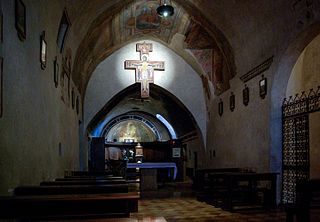
The Church of St Damian, Assisi. Photo credit Berthold Werner.

It is a time of troubles. Plagues, accelerated by the rapid growth in intercontinental trade, spread across the world with dizzying speed. The economic gap between rich and poor is yawning, and many of the young have given up on the ability of the existing order to usher in a just society and are seeking a completely fresh start, consigning the old ways to the dustbin of history with as much aggression as needed. The West and the Islamic world are at loggerheads, with Western powers embroiled in multiple bloody conflicts in the Middle East, which started so long ago that nobody much remembers how or why they started. I am not, of course, talking about the present day but about the first years of the 13th Century, a time when the older townsfolk of Devizes will still have remembered the Church of St John the Baptist being built. There is truly nothing new under the Sun. 

In that tumultuous time, a rich young party animal called Francis, whose feast we commemorate today, was having a life crisis. Set to inherit a family fortune, he had spent his youth hanging out with the troubadours, the wandering bands of minstrels who travelled around during the High Middle Ages making music, singing with them in his beautiful voice and partying with them. An attempt to settle down a little by turning his hand to soldiering had resulted in Francis spending a year as a prisoner of war. After that, his former life of drinking and dancing no longer had any appeal. He wandered the countryside of his native central Italy, half-starved and dressed in rags, begging God to show him a more meaningful way of life. One day, Francis stumbled across a church dedicated to Saint Damian, no older than the then relatively new St John’s, but already falling into disrepair. Amid the crumbling stones, he had a vision of an Icon of Christ Crucified that hung in the church speaking to him. “Rebuild my Church”, it said.

He took up the task with enthusiasm, starting with the physical rebuilding of that Church of St Damian, and going on to work for a spiritual renovation of the whole Christian world. Some of his schemes were perhaps a little overambitious: he once travelled to Cairo, reckoning that if he could only convert the Sultan to Christianity then he could end the wars connected to the Crusades. You will not be surprised to learn that he wasn’t successful.

But that isn’t the point – the point is that he gave things a go. Following Christ isn’t about following a series of step-by-step orders like the instructions for setting up a new mobile phone. As we know, that doesn’t guarantee success anyway. Richard Holloway once described the Christian journey as being less like marching to a heavenly military band and more like joining God in a jazz jam session, listening to the music God is playing and seeking to chime our own personal riffs with His. Christian obedience is about co-operating with God and recognising our own immense value to Him. God is not a cosmic sergeant-major waiting to scream at us angrily if we miss a beat. If God doesn’t pick up on the tune we’re playing, we can always get back into the beat in the next bar. New life can begin at any time. Following Christ is about trying to sense where the Holy Spirit is leading, trying different ideas, accepting that God will not pick up on some of them, because it’s only in a world of chance and risk and serendipity that other little tunes we toot can blossom into symphonies that are more magnificent than anything we could have imagined.

Read more