What Is A Man? The Question Asked by a Memorial to Forgotten Wars

The memorial to the fallen of the 1860s Wars of German Unification in the Rheinpark in Emmerich (Kriegerdenkmal, Emmerich). Emmerich is a sleepy little river port on the Rhine, literally within a casual afternoon stroll of the Dutch border.


Emmericher Kriegerdenkmal.jpg

Completed under Wilhelm Kreis in 1913 on the eve of the First World War and deeply redolent of the ‘dulce et decorum est’ mentality which played such a role in that conflagration.

Upper text: “Der ist ein Mann, der sterben kann für Gott und Vaterland. EM Arndt.” – He is a man, who can die for God and fatherland.
Read more

A Tallinn Memorial from the Days before Nationalism

Tallinn Memorial

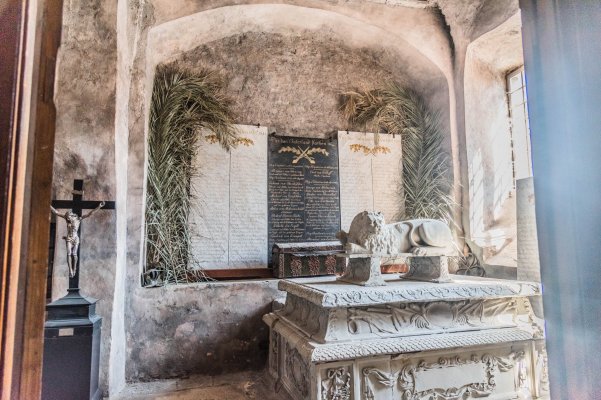
In the Toomkirik, Tallinn’s Lutheran Cathedral, this memorial to those who “für das Vaterland starben [died for the Fatherland], 1812-14”.

In the wars against Napoleon, the ‘Vaterland’ the German-speaking Protestant élite of Estonia died for was the Empire of the Tsars.

200 years ago, nationalism and the nation-state were concepts only beginning to emerge. Due loyalty was assumed to be to one’s sovereign, not one’s ethnic kinsman.

Read more

Boxing, Sculpture and ‘Degeneracy’: Joe Lewis, Max Schmeling and Rudolph Belling

Max Schmeling by Rudolph Belling

Bronze “Der Boxer Max Schmelling” by Rudolf Belling, 1928.

The divergent fates of sculptor and subject of this work are fascinating. Belling held radical views on the theory of sculpture, and his works were damned as ‘degenerate art’ (entartete Kunst) after the Nazis assumed power in 1933. He fled first to New York in 1935 and then to Istanbul two years later, where he would spend the next three decades. He had a successful academic career in Turkey, and moved back to Germany only as an eighty year-old in 1966.

Schmeling, World Heavyweight Champion from 1930-2, fought two legendary bouts against Joe Lewis. Given that Lewis was not only black, but perhaps the first African American to become a national icon, he represented another form of degeneracy for the Nazi régime and the fights had extraordinary political charge.

Read more