I Do What I Hate: Sermon Preached on 9th July 2023 (5th Sunday After Trinity)

Preached at St John’s, Devizes

Readings – Romans 7: 15–25a; Matthew 11: 16-19, 25-30

“I do not do what I want, but I do the very thing I hate.”

I wonder how familiar you are with quantum computing?

I ask, because the last interesting episode of my recent trip to North America happened on the bus out to Montreal airport to catch my flight to Heathrow. There was conversation between a man in his fifties from the United States, in town to attend an industry conference for people working in quantum computing, and a woman of about twenty who was studying computer science at one of the local universities, who was asking him all sorts of intelligent questions.

It’s much more difficult to make quantum computers to work in practice than the digital computers we’re familiar with, the man explained, but experimental prototypes work increasingly well, and it’s possible that we’re within a few years of them becoming practical. There are many wonderful things they might make much easier, like finding new vaccines. He said, however, that the first thing that will happen is that every encryption scheme in the world will become obsolete overnight. Encryption means the codes that are used to keep your debit card payments secure, your e-mails private, and the suchlike. Even the encryption used by the world’s militaries and secret services will become worthless, he explained, possibly not too far in the future. The first thing that quantum computers will do, apparently, is to force all of these vital pieces of code to be rewritten using quantum computers.

The young woman was wide-eyed – and so was I. He smiled and shrugged and said, “It’s just like when the Iron Age arrived. Up until then, anyone who had bronze weapons and armour ruled the roost. Then all of a sudden they were obsolete and people needed steel. It’s just what human beings do; we advance.”

Nowadays we’re no longer talking about swords, but things like cluster munitions. The war in Ukraine is a reminder of what how terrible long conventional wars between well-equipped large countries are. We’d almost forgotten.

Necessity, as the old saying goes, is the mother of invention, and countries fighting for their survival have needs that are acute. So war drives technological advancement. The last big international war finished with the invention of nuclear weapons. For the first time, human beings had the power to destroy ourselves entirely. In the 17 months since Russia invaded Ukraine, there has already been a revolution in some military technologies, such as the use of drones.

Read more

War and the Devil: Sermon Preached at St John’s, Devizes, Sunday 6th March 2022 (The First Sunday in Lent)

Readings – Romans 10:8–13; Luke 4: 1–13

“Jesus … was led by the Spirit in the wilderness, where for forty days he was tempted by the devil.” 

One of my favourite films is a movie made eleven years ago named Margin Call. It is a fictionalised version of 24 hours in the life of a big New York merchant bank at the start of the 2008 financial crisis.

In the small hours of the morning, two well-tailored bankers assimilate the possibility of the world economy collapsing thanks, in part, to their extreme investment risks. At one point, the younger one turns to the older and says, “This is bizarre. It’s like a dream.”

“Oh, I don’t know”, comes the reply, “Seems like we may have just woken up.”

The world of these men and women collapses in the space of a day, to their shock and horror. As the movie progresses, however, it becomes apparent that they knew all along that they were following a path that was unsustainable, but one that was making them all rich. They were lying to the rest of us, of course, but mostly they were lying to themselves. Part of the movie’s power comes from the way it depicts how the system rapidly seduces the young graduate trainees into believing that this world of greed and lies is normal, even good.

Subsequently disgraced – Kevin Spacey in Margin Call (2011).

Ironically, the wise old trader in that exchange was Kevin Spacey – soon afterwards disgraced, and deservedly so, for using his artistic genius as bait to exploit young men who dreamed of being stars.

Both the movie and the real-life story of its star are metaphors for the world of the last thirty years, which indulged itself in the myth that humanity was starting to escape the restrictions of its nature, and that freedom and prosperity for all could be best ensured by each of us pursuing our desires and demands to the maximum extent.

We need to face facts: we are never far away from the wilderness, where the Devil lurks.

Read more

Weird Travel: The German Soldiers Commemorated in A Country Where They Committed a Genocide

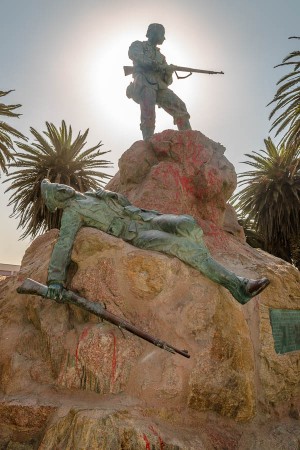
Swakopmund Marinedenkmal.jpgSwakopmund always feels a little odd, like a piece of Germany somehow teleported into Namibia’s remote and thinly populated Atlantic Coast. Even in that context, the presence of the Marinedenkmal in the centre of town feels utterly weird.

The statue memorialises the German marines who died in the suppression of the uprising of the Herero and Nama peoples in what was then German South West Africa in 1904-5. Although the plaque states that they “Mit Gott für Kaiser und Reich Kämpften” (fought with God for Kaiser and Empire), it is widely accepted that the German suppression of the rebellion was the 20th Century’s first major genocide. German troops killed not only indigenous fighters, but non-combatant men, women and children in intentional acts of collective punishment. Others were driven into the desert to die of thirst and exposure, or simply allowed to die of exhaustion. Survivors of the massacre were put into forced labour camps. Around 50% of Nama and 80% of Herero died in the revolt and the three years of collective punishment which followed.

Read more

St Pancratius, ‘s-Heerenberg, and the ‘Gestapo Window’

St Pancratius, 's-Heerenberg, North Elevation

St Pancratius (de Pancratiuskerk) in the little Dutch market town of ‘s-Heerenberg (population 8,000) and literally a ten minute stroll from the German border.

At first blush – another pretty, ornate, but unexceptional post-Vatican I church in the south eastern Netherlands, a sign of a long suppressed community bursting into both prosperity and political power. Inevitably designed by the Albert Tepe, a prolific architect of Dutch neogothic… and then…

In the north aisle a unusual piece of stained glass catches the eye – is that a Gestapo man in stained glass?

St Pancratius, 's-Heerenberg, Close Up of ‘Gestapo Window’

Yes, it is. And so one learns of the story of Frs. Galama and van Rooijen, parish priest and curate respectively, arrested in 1941 after preaching against the Dutch Nazi Party, the NSB, who were deported to Dachau where both died in 1942. The scene of the Judas kiss immediately above makes clear the bitter but rarely mentioned memories of collaboration and betrayal that must have haunted communities like this for decades after the war.

Read more

What Is A Man? The Question Asked by a Memorial to Forgotten Wars

The memorial to the fallen of the 1860s Wars of German Unification in the Rheinpark in Emmerich (Kriegerdenkmal, Emmerich). Emmerich is a sleepy little river port on the Rhine, literally within a casual afternoon stroll of the Dutch border.


Emmericher Kriegerdenkmal.jpg

Completed under Wilhelm Kreis in 1913 on the eve of the First World War and deeply redolent of the ‘dulce et decorum est’ mentality which played such a role in that conflagration.

Upper text: “Der ist ein Mann, der sterben kann für Gott und Vaterland. EM Arndt.” – He is a man, who can die for God and fatherland.

Read more