
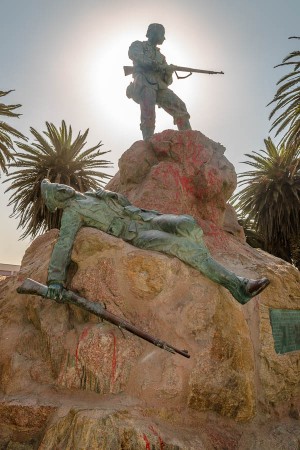
 Swakopmund always feels a little odd, like a piece of Germany somehow teleported into Namibia’s remote and thinly populated Atlantic Coast. Even in that context, the presence of the Marinedenkmal in the centre of town feels utterly weird.
The statue memorialises the German marines who died in the suppression of the uprising of the Herero and Nama peoples in what was then German South West Africa in 1904-5. Although the plaque states that they “Mit Gott für Kaiser und Reich Kämpften” (fought with God for Kaiser and Empire), it is widely accepted that the German suppression of the rebellion was the 20th Century’s first major genocide. German troops killed not only indigenous fighters, but non-combatant men, women and children in intentional acts of collective punishment. Others were driven into the desert to die of thirst and exposure, or simply allowed to die of exhaustion. Survivors of the massacre were put into forced labour camps. Around 50% of Nama and 80% of Herero died in the revolt and the three years of collective punishment which followed.