


Readings – 2 Samuel 6:1-5, 12b-19; Mark 6: 14–29
“‘He went and beheaded him in the prison, brought his head on a platter, and gave it to the girl.”
In the name of God who is Father, Son, and Holy Spirit. Amen.
Salome receiving John the Baptist’s head on a platter is one of the most grizzly images in the Gospels. It remains shocking not least because so many Christians have died throughout the ages for telling powerful rulers truths that they don’t want to hear. When you next go to Salisbury, look at the rows of statues which adorn the West Front of the Cathedral – there is a helpful Wikipedia article which has information on each one of the one hundred and ninety-six of them – and note how many of them were martyred for their faith.
The last few decades have added to the numbers of those martyred for speaking truth to power. I think of St Oscar Romero, the Roman Catholic Archbishop of San Salvador, who was shot dead by members of a far-right militia as he celebrated Mass in a hospital chapel in 1980; or Jerzy Popiełuszko, the Polish priest hunted down four years later by secret policemen of the then Communist regime in his country. In our own Anglican tradition Janani Luwum, the Archbishop of Uganda, was martyred in 1977 by Idi Amin for protesting that dictator’s murderous rule. Few people seem to know of the seven brave Anglican monks of the Melanesian Brotherhood, murdered in 2003 by a warlord in the Solomon Islands as they tried to mediate during a period of interethnic fighting. So, let me remember by name from this pulpit Nathaniel Sado, Robin Lindsay, Francis Tofi, Tony Sirihi, Alfred Hill, Patteson Gatu, and Ini Paratabatu.
Nor have these martyrs all been clergy and religious. Brave laypeople have also given their lives for refusing to collude in the lies of repressive régimes, like Steve Biko, the practising Anglican and founder of South Africa’s Black Consciousness Movement, beaten to death by the police of the apartheid state.

Indeed, it was in South Africa that I definitively got to know a prophet: David Russell, who was Bishop of Grahamstown from 1987 until 2004. David radiated the peace of Christ and was very good to me at a difficult time. He could have had a much easier life than the one he led. South Africa-born, he came to England to train for the priesthood and studied to postgraduate level at Oxford. As such an able man, he could have become a Prince Bishop of the Church of England, and campaigned against the repressive government of his homeland from a powerful pulpit. Even in South Africa, he could have ministered in a White suburban parish, and challenged the government from there. That wouldn’t have been entirely comfortable, but it would have been a lot easier than what he chose to do. Instead, he rejected the arrant heresy that a priest must be of the same race as the people he or she serves by ministering in illegal shantytowns on the Cape Flats, home to people banned from living in the second city of their own country simply because of the colour of their skin. This led to several years of house arrest, an actual spell of imprisonment, and being constantly spied upon by the security services. It also led him to meet his wife, to become a highly respected bishop important in his country’s transition to democracy, and in the fullness of time to become an officially honoured national hero. While some prophets face death, David lived to find a sort of Resurrection in his later years.
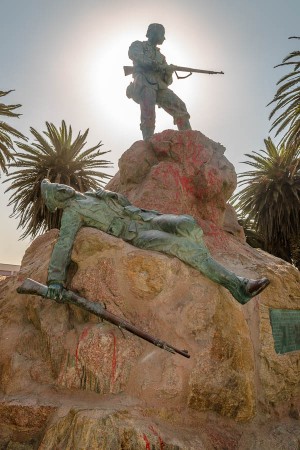 Swakopmund always feels a little odd, like a piece of Germany somehow teleported into Namibia’s remote and thinly populated Atlantic Coast. Even in that context, the presence of the Marinedenkmal in the centre of town feels utterly weird.