The Baptist’s Wounds: Sermon Preached at St John’s, Devizes, 11 July 2021 (The Sixth Sunday after Trinity)

Readings – 2 Samuel 6:1-5, 12b-19; Mark 6: 14–29                                 

“‘He went and beheaded him in the prison, brought his head on a platter, and gave it to the girl.”

In the name of God who is Father, Son, and Holy Spirit. Amen.

Salome receiving John the Baptist’s head on a platter is one of the most grizzly images in the Gospels. It remains shocking not least because so many Christians have died throughout the ages for telling powerful rulers truths that they don’t want to hear. When you next go to Salisbury, look at the rows of statues which adorn the West Front of the Cathedral – there is a helpful Wikipedia article which has information on each one of the one hundred and ninety-six of them – and note how many of them were martyred for their faith.

The last few decades have added to the numbers of those martyred for speaking truth to power. I think of St Oscar Romero, the Roman Catholic Archbishop of San Salvador, who was shot dead by members of a far-right militia as he celebrated Mass in a hospital chapel in 1980; or Jerzy Popiełuszko, the Polish priest hunted down four years later by secret policemen of the then Communist regime in his country. In our own Anglican tradition Janani Luwum, the Archbishop of Uganda, was martyred in 1977 by Idi Amin for protesting that dictator’s murderous rule. Few people seem to know of the seven brave Anglican monks of the Melanesian Brotherhood, murdered in 2003 by a warlord in the Solomon Islands as they tried to mediate during a period of interethnic fighting. So, let me remember by name from this pulpit Nathaniel Sado, Robin Lindsay, Francis Tofi, Tony Sirihi, Alfred Hill, Patteson Gatu, and Ini Paratabatu. 

Nor have these martyrs all been clergy and religious. Brave laypeople have also given their lives for refusing to collude in the lies of repressive régimes, like Steve Biko, the practising Anglican and founder of South Africa’s Black Consciousness Movement, beaten to death by the police of the apartheid state.

David Russell praying with victims of homophobic violence in Cape Town, 26 August 2011, © Gerry Lynch

Indeed, it was in South Africa that I definitively got to know a prophet: David Russell, who was Bishop of Grahamstown from 1987 until 2004. David radiated the peace of Christ and was very good to me at a difficult time. He could have had a much easier life than the one he led. South Africa-born, he came to England to train for the priesthood and studied to postgraduate level at Oxford. As such an able man, he could have become a Prince Bishop of the Church of England, and campaigned against the repressive government of his homeland from a powerful pulpit. Even in South Africa, he could have ministered in a White suburban parish, and challenged the government from there. That wouldn’t have been entirely comfortable, but it would have been a lot easier than what he chose to do. Instead, he rejected the arrant heresy that a priest must be of the same race as the people he or she serves by ministering in illegal shantytowns on the Cape Flats, home to people banned from living in the second city of their own country simply because of the colour of their skin. This led to several years of house arrest, an actual spell of imprisonment, and being constantly spied upon by the security services. It also led him to meet his wife, to become a highly respected bishop important in his country’s transition to democracy, and in the fullness of time to become an officially honoured national hero. While some prophets face death, David lived to find a sort of Resurrection in his later years.

Read more

Like A Mustard Seed: Sermon Preached at St John’s, Devizes, 13 June 2021 (The Second Sunday after Trinity)

Mustard Seeds. © Eugenio Hansen, OFS and used under Creative Commons 4.0

Readings – 2 Corinthians 5: 6–17; Mark 4: 26–34

“‘With what can we compare the kingdom of God, or what parable will we use for it? It is like a mustard seed…”

Mustard Seeds. © 	Eugenio Hansen, OFS and used under Creative Commons 4.0
Mustard Seeds. © Eugenio Hansen, OFS and used under Creative Commons 4.0

May I speak in the name of God, who is Father, Son, and Holy Spirit. Amen.

I suspect many of you remember a BBC comedy series from a decade ago called Rev. For those of you who don’t know it, it is about the trials and tribulations of an East End vicar, the Reverend Adam Smallbone, and his congregation in a gentrifying but still sometimes troubled parish. His flock isn’t very large, and sometimes their motivations for being in church are frankly mixed, from the lady of a certain age who is, shall we say, often very taken with gentlemen in clerical collars, to the incoming middle-classes who turn up to get their children into the parish primary school, without remotely taking anything that goes on in Church seriously.

A consistent theme is Adam’s sense of his own inadequacy. Adam feels inadequate compared with the vicar of the lively parish down the road, with its in-house rap artist and huge congregation of young people, and inadequate compared with his very clever pal from theological college who has a column in The Guardian and a regular slot on Thought for the Day. Yet every once in a while, an encounter happens that makes Adam realise that he is indeed called by God to be the person he is, moments of grace where only he, precisely because of his transparent flaws, can bring the light of Jesus Christ into a situation where a grander or more self-confident person would never be allowed to enter.

“So if anyone is in Christ, there is a new creation”, says St Paul in today’s Epistle reading, from the Second Letter to the Corinthians. It is natural to feel inadequate when faced with words like that. I don’t know about you, but my faults have remained persistent throughout my journey of faith. Following Jesus Christ as my Lord hasn’t turned me into a heroic crusader against evil who makes sinners repent by the sheer radiance of my goodness. I am as flawed, as self-centred, as inclined to take the path of least resistance, and sometimes as plain annoying as I always have been. 

Yet: “There is a new creation.” This is where context matters, because St Paul wrote these words to a new and immature Church in Corinth, the Eastern Mediterranean’s sin city, a city of sailors on shore leave joining the locals in hard partying and loose living. We might think of it in our terms as Amsterdam multiplied by Ibiza. Paul didn’t write those letters to the Corinthians because they were the example of what a Church should look like, but because they were the most troubled of all the churches he established – sometimes immoral, obsessed with wealth and bling, and rather selfish. And yet St Paul didn’t give up on them. They were at the beginning of a journey that they didn’t even seem to understand: but they had made a start. Great things often have small beginnings, and the people who start them are never perfect. God called the Corinthians to follow Him in His Son Jesus Christ, not because they were the models of sainthood, but because they were the people He needed to fulfil his purposes, there and then.

Read more

For the Were Afraid: Sermon Preached on 4th April 2021 (Easter Day)

Josef Žáček, Resurrection (1988). which hangs in the Gallery of Modern Art in Roudnice, Czechia.

Preached at St John’s, Devizes

Readings – 1 Corinthians 15: 1–11; Mark 16:1–8

“So they went out and fled from the tomb, for terror and amazement had seized them; and they said nothing to anyone, for they were afraid.”

May I speak in the name of God, who is Father, Son, and Holy Spirit. Amen.

Josef Žáček, Resurrection (1988). which hangs in the Gallery of Modern Art in Roudnice, Czechia.

When I was boy, the local radio station my mother always listened to in the morning had a daily feature of the wackiest snippets from the day’s papers. One Easter week, it told the story of a church on the previous Sunday, that I seem to remember was in Devon. When the parishioners arrived for the main Easter Day Eucharist, they were told that their newly installed vicar, the Reverend So-and-so, had died suddenly on the afternoon of Good Friday. Nonetheless, his wife had battled on to make the church bright and full of new life for Easter morning. The show must go on and all that.

The parishioners were distraught, some openly weeping as the service began, with a strangely hollow Gloria and then the readings. At the end of the Gospel, some strange bumping noises began to be heard from the giant, two metre-high, papier maché egg, that some of the churchgoers only at that point noticed was stationed just below the pulpit. Soon, holes began to be punched in the egg from the inside by a pair of furious fists. Suddenly, out jumped the vicar, with a cry of “Surprise!

He said his aim was to allow the parishioners to actually feel the sense of shock that the first disciples felt when they realised that Jesus had actually risen from the dead. The parishioners were, however, deeply unimpressed. I think they must have written some stiff letters to the Bishop of Exeter afterwards.

I can promise you that I shan’t resort to such histrionics at any point in my time with you at St John’s. That Devon vicar from 35 years or so ago clearly made a rather crude error of judgement. Yet, for all its emotionally manipulative crassness, his stunt did get across one easily missed point; the experience of the Resurrection was, at least at first, deeply disturbing and upsetting.

Read more

Clearing the Temple of our Souls: Sermon Preached Digitally for St John with St Mary, Devizes, on Sunday 7 March 2021

Readings – 1 Corinthians 1:18-25, John 2: 13-22

May I speak in the name of God, who is Father, Son, and Holy Spirit. Amen.

I love Giotto’s painting of the scene in the Temple in Jerusalem that forms the centrepiece of today’s Gospel. It has a raw edge that defies any domestication of Christ; Jesus, a cold fury on his face, is whirling the whip above his head, but he looks more than anything like he’s about to punch the moneychanger nearest him in the face. 

The reception of this story by the Church in the present moment fascinates me. The Giotto painting is the source of countless memes, little social media slogans, in the churchy parts of Facebook and Twitter, where people say that Jesus angrily whipping the money changers out of the Temple is the Jesus they emulate. The funny thing is the same people find the idea of the wrath of God absolutely taboo, as I suspect most of us do, dismissing it as primitive and theologically dubious. 

We don’t like the idea of God’s wrath in the abstract, but we like the angry Jesus when his fury is directed at people we disapprove of. After all, we’re not the sort of people who would set up a stall in the cloisters at Salisbury Cathedral to sell animals for sacrifice and exploit continental tourists by offering them a terrible exchange rate for their Euros. It’s OK for God to be angry at people like that, the sort of people who make us feel a bit smug and superior, but we’re quite sure God would never be angry at us. 

We only need to spell that approach out to realise how ludicrous it is, a cheap co-option of God as a sort of magic totem who is always on our side. Please God, we’re more mature and self-aware than that, open to understanding that the Jesus who judges the moneychangers has not only the right, but the duty, to judge us. We must know that the God who knows every hair on our head also knows the darkness that rests in each of our souls. We also know that any representation of a human being without shadow isn’t a human being at all but a cartoon, a caricature, and that anyone claiming to be such a flawless being is a liar. If Jesus Christ, who is God, is correct to be angry at the moneychangers in the Temple, then He must also at times be correct to be angry at us.

Read more

Touched by an Angel?

Article originally published in the October 2020 issue of the magazine of St John’s, Devizes.

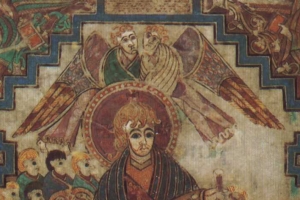
Angels guard Christ from above. Folio 220r from the Book of Kells (illuminated ca. 800).

I started my first day as a curate with a swim. It hadn’t been planned in advance. Waking early on a bright and cloudless midsummer morning, I decided to cycle along the canal to Bishops Cannings. Despite noting with concern how narrow the towpath became as it passed the Marina, I felt invigorated by the deep orange sunshine on my face and cool air in my lungs. Due to be commissioned as a Licensed Lay Worker that afternoon, a milestone on a very long journey to ordained ministry, I felt gloriously and intensely alive.

The next thing I knew, my bike had somehow made a ninety degree turn and toppled down the bank of the canal, plunging vertically like the Titanic, and catapulting me through the air like a rodeo rider being thrown. I felt mud in my hands as I scraped the bottom. I couldn’t manage to heave my old boneshaker back up the bank, so I trudged home on foot, soaked and stinking of carp. Worse still, my mobile phone died – it was my only internet connection as my broadband wasn’t connected yet, and I needed to be able to get on Zoom to be licensed. What an inauspicious start to a momentous day!

I said some lairy things to God as I showered. On that day of all days, couldn’t He have protected me from such ignominy? Yet I later began to wonder if He hadn’t arranged that strange swerve to my own benefit. Let me explain.

Read more