Worship is Worth It: Sermon Preached on 29th January 2023 (Fourth Sunday after The Epiphany)

Preached at Evensong in St Mary the Virgin, Bishop’s Cannings

Genesis 28.10-22; Philemon 1–16

“…this stone, which I have set for a pillar, shall be God’s house.”

Philemon is not a text that preachers tend to thank the lectionary for throwing their way. Nonetheless I think it has quite a bit of interest to say to us here this evening, especially when paired with our Old Testament reading from Genesis, one of the most famous passages from that book, Jacob’s Ladder. Evensong often gives us the chance to engage with parts of the Bible that are rarely read in the Sunday morning lectionary. Tonight it certainly has.

White angels climbing up and down a ladder, representing a famous vision of Jacob in Genesis 28. A red sunset hovers overhead and a dark town is in the background. This is a painting by Mark Chagall from 1973.
Chagall, Jacob’s Ladder (1973).

There is often debate in the Church about whether the Church’s primary job is to help the needy or to worship almighty God. We often hear a similar debate about evangelism, where some argue it should be de-prioritised or even avoided entirely for the sake of helping the poor. In his letter to Philemon, St Paul sees all these things as being intimately connected with one another and mutually reinforcing one another. He prays for Philemon that “the communication of thy faith may become effectual by the acknowledging of every good thing which is in you in Christ Jesus”. It is when we take time to recognise the good that Jesus Christ does in us and through us, and to thank Him for that in prayer, that we become effective in sharing our faith.

Philemon is a difficult document because in it Paul discusses Onesimus, a runaway slave, with Philemon, who is his owner. Any thought of doing anything other than condemning slavery makes us outraged, and rightly so. The sad reality, however, is nearly every human society, on every continent, began practising slavery as soon the development of agriculture made it practical. What more demonstration of the reality of original sin do we need?

Indeed, while our first instinct when reading this letter is to stand in pious judgement over St Paul and the Roman Imperial society that produced him, we might consider that for all their faults, the Romans never came close to threatening the planet’s capacity to support human life, something we’ve done remarkably quickly through nothing more sophisticated than burning a bit of coal and oil. We are very quick to judge those of the past perhaps precisely because we know that us people of the present are, for all our wealth and technological power, just as flawed as our ancestors.

So, I think part of what this difficult letter has to teach us that there is no perfect social or political order and that there never will be — we must live our lives as Christians and seek to do good and follow Christ in a world that will always have dark aspects. We can, of course, work to change the political system and the laws we live under. Christianity supplied most of those who led the worldwide abolition of slavery in the century before last and we thank God for them. But we won’t always succeed in our attempts to make the world a better place; in fact sometimes we won’t even be pushing for the right things. Attempts to create utopia, to actually build heaven on earth, have usually led to hellish outcomes; the first society to reintroduce forms of slavery after having previously abolished the practice was the Soviet Union, which claimed to be a staging-post towards the perfect system of governing the world.

Read more

Angels: Sermon Preached at St John’s, Devizes, Saturday 25th December 2021 (Christmas Morning)

And suddenly there was with the angel a multitude of the heavenly host, praising God

Most of us probably know all the people who were mentioned in the Gospel reading a moment ago, when the Rector stood in front of the altar and read from the big blue book. There are the angels; and there are the shepherds; and there is the Holy Family of Mary, Joseph, and the Baby Jesus. Let me say a little bit about each of them to help you think about what Christmas means and how you can ask God for help in your life.

An image of The Mystical Nativity, by Sandro Botticelli (1500-1), which now hangs in The National Gallery, London.
The Mystical Nativity, by Sandro Botticelli (1500-1). Now hangs in The National Gallery, London.

Let’s start with the angels. Some people laugh at the idea there are angels. But there is more going on in the world than is obvious from our senses, and many people who aren’t even sure if they believe in God do believe in angels. This is a bit odd, as angels are God’s messengers. If you believe in angels, you should believe in God. Trust your guardian angel to look after you; they will be with you to protect you for your whole life. Just try your best to stay out of trouble and not give the angel too much work!

If you find it hard to pray to God, you can ask your Guardian Angel to pray for you, and to teach you how to pray for yourself.

Read more

Touched by an Angel?

Article originally published in the October 2020 issue of the magazine of St John’s, Devizes.

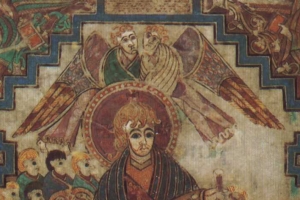
Angels guard Christ from above. Folio 220r from the Book of Kells (illuminated ca. 800).

I started my first day as a curate with a swim. It hadn’t been planned in advance. Waking early on a bright and cloudless midsummer morning, I decided to cycle along the canal to Bishops Cannings. Despite noting with concern how narrow the towpath became as it passed the Marina, I felt invigorated by the deep orange sunshine on my face and cool air in my lungs. Due to be commissioned as a Licensed Lay Worker that afternoon, a milestone on a very long journey to ordained ministry, I felt gloriously and intensely alive.

The next thing I knew, my bike had somehow made a ninety degree turn and toppled down the bank of the canal, plunging vertically like the Titanic, and catapulting me through the air like a rodeo rider being thrown. I felt mud in my hands as I scraped the bottom. I couldn’t manage to heave my old boneshaker back up the bank, so I trudged home on foot, soaked and stinking of carp. Worse still, my mobile phone died – it was my only internet connection as my broadband wasn’t connected yet, and I needed to be able to get on Zoom to be licensed. What an inauspicious start to a momentous day!

I said some lairy things to God as I showered. On that day of all days, couldn’t He have protected me from such ignominy? Yet I later began to wonder if He hadn’t arranged that strange swerve to my own benefit. Let me explain.

Read more