Buckfast Abbey

A meeting recently took me to Buckfast Abbey, a first visit. This is a Benedictine Abbey in the heart of rural Devon. It was a midwinter day of strong sunshine and stronger showers, which allowed for some dramatic photography.

Dating back to late Saxon times, Buckfast Abbey was suppressed by Henry VIII in 1539 (frankly, it was already quite decayed and the remaining monks accepted generous payments to repudiate their sacred vows and go quietly). In the early 1800s, almost all the buildings were demolished by a local landowner to make way for a large house. In 1882, some French Benedictines returned to re-establish a community there, which survives to this day.

They immediately built a temporary chapel (the grey buildings on the right) before the current main Abbey church was built, to a design by Frank Walters, from 1906-32, with the tower completed in 1938.Buckfast Abbey, South West Elevation

For me, the crowning glory is Dom Charles Norris’ stunning 1968 east window of Christ at the Last Supper in the 1965 Blessed Sacrament Chapel at Buckfast Abbey. Modernist and depicting a definitely post-Vatican II vision of Catholicism. Thick tiles of glass, chipped to shape and set in concrete or epoxy resin.

Read more

In response to Owen Jones: In Defence of the Establishment of the Church of England

Owen Jones’ appeal for the separation of church and state showed a deep respect for Christianity in general and the Church of England in particular. But he failed to explain how and why disestablishment would be an improvement. Throughout the article, I only read one serious criticism of the status quo: that it is an ‘anachronism’.

Perhaps so – the relationship between Church and state in Britain is certainly illogical. The monarch swears in the Coronation Oath to maintain the “Protestant Reformed Religion established by law”, but Britain doesn’t have an established Church. England has one, and Scotland has a different one, more thoroughgoingly Protestant than the curious part-Catholic hybrid south of the border. No kirk celebrated Holy Week like we did at St Martin’s in Salisbury, with prostrations before the Blessed Sacrament and kissing of the cross. Wales, like Northern Ireland, gets by without an established church.

Indeed Northern Ireland argues against disestablishment as a means of promoting good relations between faith communities. The Church of Ireland was disestablished fifty years before Northern Ireland’s creation, and was in any case the minority Protestant tradition in the new state. That didn’t prevent a horrendous history of state-sanctioned anti-Catholic discrimination, nor a descent into thirty years of ethno-religious violence.

Read more

No Simple Answers for Christians in Politics

I’ve enjoyed the series of posts hosted by Gillan on God and Politics UK, where guest bloggers associated with the three main GB political parties, as well as the Greens and UKIP, say they support their particular party from a Christian perspective. Two final articles are from someone saying he finds it hard to vote, and someone who says voting is a Christian duty.

I was a member of both the Liberal Democrats for many years and was heavily involved in the Alliance Party of Northern Ireland for a long time. I’m not a member of any political party at the moment. Given the events of the past 16 months in Northern Ireland, I doubt I could vote for anyone other than Alliance just now, but I’m living in Wiltshire and I don’t know who to vote for in Great Britain. Not voting at all is certainly an option, although one I’d take only with great reluctance. I might return to how all that fits with being a Christian in a later blog post, but just for now I thought I’d ask a few questions of the philosophy behind the series.

It seems to have been taken as a given by all the posters except Frank Cranmer, who isn’t voting, that it is a good thing that Christians are involved in politics; and that the world would be a better place if more of them were. Indeed, Daniel Stafford argues very directly that Christians should get involved both in the party which most closely reflects their beliefs, and that party’s internal Christian grouping. This view is a common assumption in British Christianity, indeed an unusual case of an assumption that cuts right across Evangelicalism, Roman Catholicism and Liberal Christianity. How valid is it?

Read more

Some Thoughts on Tony Benn

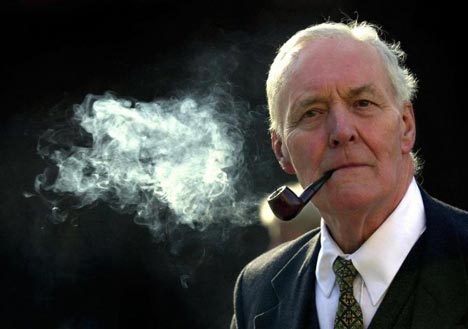
TonyBennTony Benn was a lovely guy. I once got chatting to him on the Circle Line going home from work: I got on at St. James’ Park and said “Hey, you’re Tony Benn!”, and we chatted until he got off at Notting Hill Gate. He was just like that. Great company, totally unspun, absolutely principled. And, even better, he wore tweed jackets and smoked a pipe.

Unfortunately, he was a bloody awful cabinet minister, and the government he last served ultimately tested beyond destruction the post-war consensus, paving the way for Thatcher and all that came with her. He was one of the prime reasons for that. In the mid 1970s Britain was a more economically equal country than it has been before or since; there was never a better time for a young adult from a poor background to come of age. It was rapidly on the way to becoming a more inclusive society of minorities as well. EEC membership was helping British industry discover new markets, and Britain was finally catching up with the rest of Western Europe on living standards after a lost generation.

Read more

Categories UK

UKIP’s voters – older, more male and more working class. But especially older.

Cross-posted at Slugger O’Toole

YouGov have produced a wonderful composite of all their February 2013 polling to try and give a realistic picture of which bits of the electorate are behind UKIP’s polling surge into double figures , a trend which was clear well before the party pushed the Tories into third place in the Eastleigh by-election last week. There are reasons why one needs to be slightly cautious about polling composites, but with 28,944 total respondents and 2788 UKIP supporting respondents, this is a significant piece of opinion research.

I was alerted to it by a good analysis piece Jonathan Jones put on the Spectator blog yesterday. I don’t particularly disagree with anything that Jonathan wrote in that piece, although I think I come to a slightly different set of conclusions than he has.

The biggest variation from the general population characteristic of UKIP voters in YouGov’s surveys is that they are more likely than average – much more likely than average – to be old. While 38% of the electorate is aged between 18 and 40, only 15% of UKIP’s voters are young. On the other hand, UKIP voters are more than twice as likely as the general population to be over 60 (48% as opposed to 28%). YouGov hasn’t drilled down further into this oldest age cohort, and if they did I suspect we would find the concentration of UKIP voters got even higher among over 70s and then over 80s.

Read more

Eastleigh: Bad for Tories, Better for LDs, Best for UKIP

Cross-posted to Slugger O’Toole

So the LibDems held on to Eastleigh by a narrow majority of 1,771 or just 4.3%, with UKIP surging into second place. Alex Massie in the Speccie warns against overanalysing by-elections, while Martin Kettle argued last week in the Guardian that this was the most crucial by-election in decades. I’m inclined to agree with Kettle – I think this could well be a by-election that sets the psephological scene for the next election.

I wonder will this be a ‘canary in the coalmine’ by-election reminiscent of South London’s unglamorous Mitcham and Morden in 1982, one of only a handful of government by-election gains since the war. In that case only a very modest fall in the Tory vote was coupled with a huge defection of erstwhile Labour voters to the SDP/Liberal Alliance, seeing a comfortable Tory gain against a split centre-left, prefiguring what happened in literally dozens of seats in the 1983 General Election.

Read more

Steven Agnew cleans Arlene Foster’s clock on gay marriage…

Well done to Green Party MLA Steven Agnew for setting DUP Enterprise Minister Arlene Foster straight that civil partnerships are NOT equal to marriage and that all religious symbolism or language in civil partnership ceremonies in the UK is banned – by civil law. The scary thing, Arlene is about as gay-friendly gets in the … Read more

House Prices Rise 43-fold since 1971 – Cui Bono?

The Daily Telegraph highlights a report by Shetler indicating that house prices have risen by 43 times since 1971. This is over six times the rate of inflation for basic weekly groceries in the same period.

The report comes with the usual train of interesting factoids:

The charity said that the typical value of a house had increased by just over 43 times since 1971, from £5,632 to £245,319.

If a family’s weekly shop had increased at the same rate, it would now stand at £453, which is six times the actual figure of around £75.

Applying the house price rate of inflation to everyday food and drink items means that a bunch of six bananas would cost £8.47, a four-pint carton of milk would cost £10.45 and a leg of lamb would be £53.18, Shelter said.

Another recent Telegraph story pointed out that home ownership in the UK has now fallen to levels last seen in 1987. The level of renting from council and other social landlords has fallen dramatically In other words, the long-term effect of the policy of right-to-buy for council tenants and deliberately stoked house price inflation has been a singificant move of people, especially younger and poorer people, out of the social rented sector and into the private rented sector. As anyone who lives on a council estate knows, that usually means younger families living in identical houses on the same estates as their parents, except at higher levels of rent, with less security of tenure and often with poorer maintenance.

Cui bono is always the first question worth asking in politics. Who has benefited from the shift in housing policy away from being principally about providing a decent home for all towards being principally about providing a high-value asset for home owners?

Read more

Categories UK

Home Rule, Rome Rule and Gay Marriage

Crossposted at Slugger O’Toole

Last September, Unionists paraded in their tens of thousands through Belfast to celebrate the centenary of the Ulster Covenant. From the days of Lilibullero in the 17th Century, Ulster Protestantism has always had a particular genius for summing up its political causes in easily remembered ditties and catchphrases. Perhaps the easiest slogan to remember of all from that era is “Home Rule is Rome Rule”.

That encapsulated the fears that Irish self-government would inevitably lead to a clericalised, priest-ridden state. Such fears were reasonable given that centralised Papal power, a more modern development than popular understanding remembers, was at its apogee and Ireland lacked the liberal anti-clerical element that kept the Roman Catholic Church in check in continental Catholic countries. Indeed, the reality of the post-1922 Southern state amply vindicated those fears – civil divorce was not legalised until 1996.

That makes the constellation of forces at Westminster that unsuccessfully opposed the introduction of marriage equality in England and Wales this week all the more unlikely. The Roman hierarchies in Scotland and England/Wales have opposed the introduction of marriage equality with a degree of clerical vitriol reminiscent of the days of Cardinal Bourne, while eccentric Tory MP Jacob Rees-Mogg stated on Radio 4 that “I take my whip from the hierarchy of the Roman Catholic Church.”

Read more