St Nicolai, Kalkar

St Nicolai’s Church in the town of Kalkar (115km north of Cologne, 150km SE of Amsterdam) on the German Lower Rhine a wonderland of woodcarving from the late 15th and 16th Centuries, where a remarkable cast of woodcarvers found themselves with the patronage of wealthy religious brotherhoods. The most remarkable trio were Arndt van Zwolle, working at the end of the 15th Century, and later on Arnt van Tricht and Heinrich Douvermann.

I have not done this remarkable church justice: I needed both a tripod and time in this very dark building, neither of which I had. But I hope I will at least wet your appetite.

Kalkar 1

The story of St Nicolai’s probably began in 1230, but became really interesting after it was rebuilt after a devastating fire in 1409. The superstructure was substantially rebuilt into its current form by 1421, but it is the wonderful woodworking from the period around 1488-1560 that makes this perhaps the most celebrated church on the Lower Rhine.

The church has nine surviving woodcarved altars from a remarkable period of creativity between around 1488 and 1560. Five are at least partly visible in this shot. Nearest to camera are, left, the 1535 Trinity Altar, and, right, the 1541 St John’s Altar, both by the remarkable Arnt van Tricht. The central chandelier with the Virgin Mary took from 1508-41 to execute: van Tricht and Douverman were both among the artists who worked on this. The high altar dates to 1488-1500.

Kalkar 2

Arndt van Zwolle’s magnificent oak High Altar: begun in 1488, it was still incomplete at van Zwolle’s death, and finished by Jan van Halderen and Ludwig Juppe from 1498-1500. Worked in oak, it shows a multiplicity of scenes from the life of Christ crowned by the Calvary. There are a total of 208 figures carved. Behind it is the stained glass installed in the year 2000, the originals having been destroyed a long time in the passt. These were executed by Karl-Martin Hartmann, a physicist as well as an artist, using motifs like Feynman diagrams, galaxies, and spectroheliographs.
Read more

A Tallinn Memorial from the Days before Nationalism

Tallinn Memorial

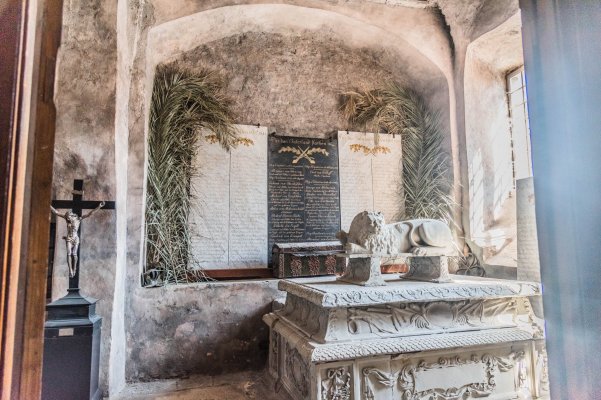
In the Toomkirik, Tallinn’s Lutheran Cathedral, this memorial to those who “für das Vaterland starben [died for the Fatherland], 1812-14”.

In the wars against Napoleon, the ‘Vaterland’ the German-speaking Protestant élite of Estonia died for was the Empire of the Tsars.

200 years ago, nationalism and the nation-state were concepts only beginning to emerge. Due loyalty was assumed to be to one’s sovereign, not one’s ethnic kinsman.

Read more

Mariken van Nieumeghen aka Little Mary of Nijmegen

Stevenskerk-18.jpg

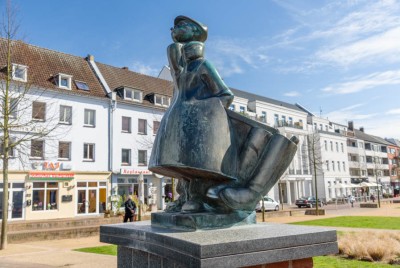
This bronze statue has been on Nijmegen’s Grote Markt, by the entrance to the Stevenskerk, since 1956 and was executed by Vera Tummers-Van Hasselt. It represents Mariken van Nieumeghen (Little Mary of Nijmegen) one of the symbols of the city in one of the best loved pieces of medieval Dutch literature.

According to a miracle play probably written between 1485 and 1510 in Antwerp, Mariken lived with the devil for seven years. Mariken had to go into town to do some shopping for her uncle. By the time she finished, it was already too late to go home, and she was not welcome to stay with her aunt in the city.

Wandering through the countryside, she met the Devil, who presents himself as Moenen. Moenen persuaded Mariken to accompany him to Antwerp. There, they led a very dissolute life for years. But Mariken wanted to see her family again. Together Mariken and Moenen returned to Nijmegen. Once there, Mariken sees a pageant, which demonstrates that everyone can receive forgiveness from God for their sins, which brings Mariken to repentance.

Read more

Meet the Box-Setts: the Demographic that Will Decide Britain’s Future

Originally posted at Slugger O’Toole…

David Box gives his partner Seema Sett the dorky, Mr Bean-ish look, with the back of his tongue poking out of his gob that he knows always makes her smile when she’s had a rough day. The kids are asleep and they’re in bed too, sprawled on top of the duvet. The tablet is streaming one of their favourite series: Babylon 5. Season 2, the episode where the Technomages first appear. Pure nostalgia for their student days. They’re both a bit geekly about sci-fi: maths graduates, what do you expect? Lying prone, she stretches her hand up, strokes his face, says she’s tired but if he wants to turn that bloody thing off, she has something else in mind before they go to sleep.

If past general elections were defined by demographics spoken about for months in advance – Essex Man, Mondeo Man, Worcester Woman – the surprise results of 2017’s snap poll were driven most of all by Mr Box and Ms Sett: the people whom nobody saw coming and nobody much realised existed. This year’s local elections shows that they haven’t gone away.

Middle-class, entering middle-age, and hitherto deeply depoliticised, last year they voted for a Labour Party led by an overt Marxist perhaps to their own surprise and in numbers that still haven’t really seeped into the consciousness of political analysts and pundits a year later: 50% of 35-44 year olds voted for Corbyn’s Labour last June. At the point in their lives when their financial commitments and personal responsibilities are greatest, with kids at school and jumbo mortgages barely starting to be paid off, only 30% opted for Theresa May’s message of Tory stability.

On Epochal Political Shifts

In the late 1970s, it was young, prosperous, skilled, blue-collar workers who were about to deliver a radical change in the balance of political opinion in Britain. Detaching themselves from family loyalties to Labour that had existed for the two generations since poor Britons first won the vote, they flocked to Margaret Thatcher’s message of hard work, self-reliance, and opposition to the choking stranglehold of bureaucracy and unions.

Thirty years later, that vision is looking increasingly hollow to those who were schoolchildren during the Thatcher revolution, from the bottom of the social scale to the top. Those who work in the public sector haven’t seen an inflation-matching pay rise for eight years, which puts downward pressure on wages even for those in the private and third sectors. The house price spiral keeps them trapped on the same step of the housing ladder if they’re lucky enough to have bought; if they rent, costs are spiralling even more rapidly, while security of tenancy has vanished and is usually hemmed in with massive deposits and restrictive clauses that would have been unimaginable in their turn-of-the-millennium house shares. Both last year’s election and this one’s took place during a round of staff cuts in their children’s schools that went unnoticed by the national press, still less by the strategists who ran the Tory election campaigns.

Read more

Statues of Kleve

Kleve, best known as the home of Anne of Cleves, is a county town in the German state of Northrhine-Westphalia, just 10 kilometres from the Dutch border, with a population of just under 50,000 – and an interesting collection of statues.
Statues of Kleve (6 of 8)

Officially called ’The Little Cobbler of Kleve’ (Klever Schüsterken), everyone calls this the Spitting Statue (Spuckmänneken) – for obvious reasons when the fountain is turned on. After the notorious Netherlands-West Germany 1990 World Cup quarter-final, local wags bedecked it in a Frank Rijkaard Dutch national team jersey! Again, officially, this 1951 statue by Joseph Brüx commemorates Kleve’s shoe industry – the city was long Germany’s capital of children’s shoes.

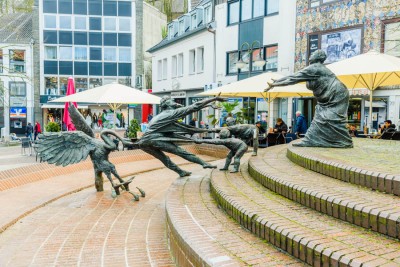
Statues of Kleve (1 of 8)Made by Karl-Henning Seemann in 1984-6, the Lohengrin Fountain statue in the heart of Kleve’s pedestrian precinct – informally called the Elsa Fountain – tells the story of Kleve’s mythical founder as related by Wagner.
Princess Beatrix lived in the Swan Castle just above the fountain around a thousand years ago. During a walk along the Rhine. she was approached by a Swan who wore a gold chain around its neck, pulling a boat on which a Knight stood, who told her he had come to defend her country. Beatrice fell in love with him and wanted to marry him. He said “yes” under one condition: that she never ask about his name or origin. The couple was happy and had three sons who, over time, became curious and tried to find out where their father came from. Eventually, Beatrix asked forbidden question to her Swan Knight. With a sad face he replied, “My name is Elias and I come from the earthly paradise”. Immediately the Swan appeared and then vanished with the Knight. Beatrice died a few months later of a broken heart.

The statue shows the Swan Knight’s sons desperately trying to stop him from being taken away, as Beatrice looks on helplessly.

Statues of Kleve (4 of 8)

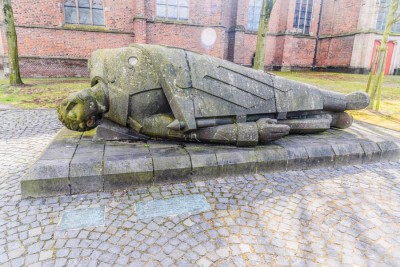
Right beside the Collegiate Church in Kleve, the Dead Warrior (Toter Krieger) statue by Ewald Mataré was erected as part of a World War One memorial originally in 1932. In 1938, it was removed and buried by the Nazis as so-called ‘degenerate art’: although perhaps in reality it was rather too honest an artistic statement about the consequences of industrialised total war for people who were about to start another one. In 1977, parts of the figure were accidentally discovered and it was restored and re-erected as a “warning against injustice and violence” in 1981. The biblical quote on the ground beside it is an extract from the First Letter of Peter – “Those who desire life avoid evil and do good: they seek peace and pursue it”.

Read more

On Charlie Kennedy

Charles Kennedy in Glasgow in 2009. Photograph (C)
Charles Kennedy in Glasgow in 2009. Photograph (C) “Moniker42” on Wikimedia Commons under CC 3.0.

Originally posted at Slugger O’Toole

There’s lots of talk about Charlie Kennedy’s talents and his ‘flaws’, often a euphemistic way of talking about his alcoholism. Alistair Campbell has blogged movingly and directly about their shared illness. It was never exactly a secret.

I remember canvassing a man in the 2004 European election campaign, a rather grand chap in a very wealthy street just north of Kensington Gardens. “Oh, the Liberals”, he sneered, “Couldn’t possibly vote for a party led by an alcoholic.” “I take it then, Sir”, I replied, “You wouldn’t have voted for Churchill?” “Not the same thing at all”, he shouted, slamming the door.

Every time I re-tell the anecdote, someone points out that he had a point: Charles Kennedy wasn’t exactly Winston Churchill. Undoubtedly, but he was a first-class politician and, until recently, his flaws would have been less relevant and his gifts more valued. In the 1970s, The Times famously opined that George Brown drunk was a better man than Harold Wilson sober. That was a questionable statement, but when it came to leading his party and giving it direction, Charles Kennedy was unquestionably a better man than either of his decidedly sober successors.

Read more

Ryanair Takeover of Aer Lingus Blocked by EU Commission

The European Commission has blocked Ryanair’s proposed takeover of Aer Lingus. Good news for Northern Ireland, as Dublin Airport’s rapid growth and improved northern road connections has made it the key long-haul transport hub for the region. Although locally in Belfast, Easyjet, Flybe and BMI remain stronger, a merger of the two main Irish airlines into … Read more

Italy’s Five Star Movement – is this what The End of History looks like?

Cross-posted at Slugger O’Toole and Lucid Talk

In 1992, Francis Fukayama predicted in The End of History that the end of the Cold War would impend not only an era of triumphant liberal-democratic capitalism, but one where political evolution had reached its final form. Western democracy, he argued, was the best form of state organisation practically achievable by humans.

The folly of such naïve Western triumphalism, already being challenged by China’s authoritarian wave of economic growth when Fukayama wrote his book, was laid bare by Mohamed Atta and his accomplices on September 11th 2001, before finally being buried by America’s failure to create new orders in Iraq and Afghanistan. But within Western societies, it could be argued to have some grain of truth.

The class-driven politics of the greater part of the 20th Century is dead in nearly every established democracy. The model of working-class left and bourgeois centre-right was in trouble long before the implosion of the Soviet empire. Technological changes and, arguably, the success of European-style welfare states in expanding the middle-class rendered its logic outdated.

Read more

Copernicus’ “Google Doodle” and the Polish-Lithuanian Commonwealth

copernicus_2485492b

Crossposted at Slugger O’Toole

Sunday past was the 413th anniversary of the execution of Giordano Bruno (burned at the stake for heresies such as proposing that the Sun is a star and that the other stars in the sky are also Suns, probably accompanied by planets very much like ours). Today, more auspiciously, is the 460th anniversary of the birth of Nicolaus Copernicus. He managed to postulate that the solar system revolved around the Sun, rather than the Earth, while remaining a Chapter Canon of Frombork Cathedral and important local civil servant during the early decades of the Reformation. Gallileo was put under house arrest for saying much the same things less than a century later and 1500km or so to the south. Times change.

It took time for the Reformation to settle into the political and military battle it later became. The Peasants’ War in 1524 encouraged both Catholic and Protestant rulers in German-speaking Central Europe to play a cautious hand and, in almost all cases, co-operate to serve their common interests. The England of Henry, Mary and Elizabeth, however, with its fanaticism of both Puritan and Ultramontane varieties, murderous dissolution of the monasteries, Secret Police and bloody executions of religious dissidents was an unusual epicentre of violent fanaticism in the Reformation’s early decades. But then England had always tended to be a little bit fanatical when it came to religion. Here, alone in the Catholic world, the laity were banned from reading the Bible in the vernacular before the Reformation, the electrifying effect of Wycliffe’s late 14th Century translation terrifying the authorities. The continent-spanning cult of martyr-pilgrimage surrounding Thomas a Becket at Canterbury Cathedral also marks England out as an unusually devout country with a history of religious intolerance and brutality by the state. English latitudinarianism and later secularism needed to have Puritanism test itself to destruction during Cromwell’s Commonwealth before it found fertile territory.

Read more

The Silence of Lost Worlds and the Fate of the Middle East’s Christians

Crossposted at Slugger O’Toole

Monasteries are very quiet places indeed. Garrulous as I am beyond the normal Irish capacity for such things, I am not someone obviously identifiable as a great lover of silence. At the Community of the Resurrection, even here in the heart of West Yorkshire’s network of densely populated post-industrial valleys, the daytime silence between the offices can be intense. The stillness is broken only by the occasional fall of well-shod feet along the corridor or the distant call of an ambulance siren carried on the breeze.

My mind fills often fills the void with sounds of its own imagining. Often these are pieces of classical music which I have loved but not listened to for a few years – the pounding drum and sinister, relentlessly advancing, cellos of the opening of Britten’s Sinfonia da Requiem or the bizarre intermingling of funeral march and chaotically joyful klezmer band that is the feierlich und gemessen movement of Mahler’s First Symphony.

Samuel Goldenberg
Viktor Hartmann’s Samuel Goldenberg

Jewish klezmer bands were a familiar feature of the Bohemia of Mahler’s youth. In the week after Holocaust Memorial Day, there is no need for explanation why they are no longer a feature of life in the 21st Century Czech Republic.

Read more