Mariken van Nieumeghen aka Little Mary of Nijmegen

Stevenskerk-18.jpg

This bronze statue has been on Nijmegen’s Grote Markt, by the entrance to the Stevenskerk, since 1956 and was executed by Vera Tummers-Van Hasselt. It represents Mariken van Nieumeghen (Little Mary of Nijmegen) one of the symbols of the city in one of the best loved pieces of medieval Dutch literature.

According to a miracle play probably written between 1485 and 1510 in Antwerp, Mariken lived with the devil for seven years. Mariken had to go into town to do some shopping for her uncle. By the time she finished, it was already too late to go home, and she was not welcome to stay with her aunt in the city.

Wandering through the countryside, she met the Devil, who presents himself as Moenen. Moenen persuaded Mariken to accompany him to Antwerp. There, they led a very dissolute life for years. But Mariken wanted to see her family again. Together Mariken and Moenen returned to Nijmegen. Once there, Mariken sees a pageant, which demonstrates that everyone can receive forgiveness from God for their sins, which brings Mariken to repentance.

Read more

Boxing, Sculpture and ‘Degeneracy’: Joe Lewis, Max Schmeling and Rudolph Belling

Max Schmeling by Rudolph Belling

Bronze “Der Boxer Max Schmelling” by Rudolf Belling, 1928.

The divergent fates of sculptor and subject of this work are fascinating. Belling held radical views on the theory of sculpture, and his works were damned as ‘degenerate art’ (entartete Kunst) after the Nazis assumed power in 1933. He fled first to New York in 1935 and then to Istanbul two years later, where he would spend the next three decades. He had a successful academic career in Turkey, and moved back to Germany only as an eighty year-old in 1966.

Schmeling, World Heavyweight Champion from 1930-2, fought two legendary bouts against Joe Lewis. Given that Lewis was not only black, but perhaps the first African American to become a national icon, he represented another form of degeneracy for the Nazi régime and the fights had extraordinary political charge.

Read more

Statues of Kleve

Kleve, best known as the home of Anne of Cleves, is a county town in the German state of Northrhine-Westphalia, just 10 kilometres from the Dutch border, with a population of just under 50,000 – and an interesting collection of statues.
Statues of Kleve (6 of 8)

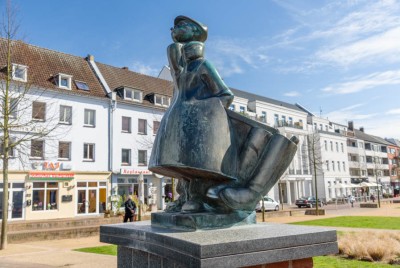
Officially called ’The Little Cobbler of Kleve’ (Klever Schüsterken), everyone calls this the Spitting Statue (Spuckmänneken) – for obvious reasons when the fountain is turned on. After the notorious Netherlands-West Germany 1990 World Cup quarter-final, local wags bedecked it in a Frank Rijkaard Dutch national team jersey! Again, officially, this 1951 statue by Joseph Brüx commemorates Kleve’s shoe industry – the city was long Germany’s capital of children’s shoes.
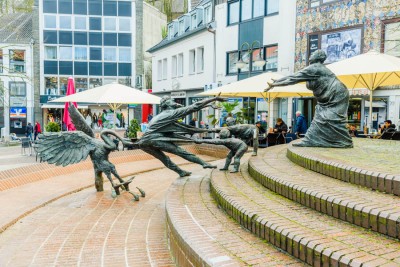
Statues of Kleve (1 of 8)Made by Karl-Henning Seemann in 1984-6, the Lohengrin Fountain statue in the heart of Kleve’s pedestrian precinct – informally called the Elsa Fountain – tells the story of Kleve’s mythical founder as related by Wagner.

Princess Beatrix lived in the Swan Castle just above the fountain around a thousand years ago. During a walk along the Rhine. she was approached by a Swan who wore a gold chain around its neck, pulling a boat on which a Knight stood, who told her he had come to defend her country. Beatrice fell in love with him and wanted to marry him. He said “yes” under one condition: that she never ask about his name or origin. The couple was happy and had three sons who, over time, became curious and tried to find out where their father came from. Eventually, Beatrix asked forbidden question to her Swan Knight. With a sad face he replied, “My name is Elias and I come from the earthly paradise”. Immediately the Swan appeared and then vanished with the Knight. Beatrice died a few months later of a broken heart.

The statue shows the Swan Knight’s sons desperately trying to stop him from being taken away, as Beatrice looks on helplessly.
Statues of Kleve (4 of 8)

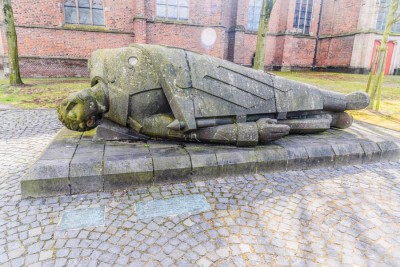
Right beside the Collegiate Church in Kleve, the Dead Warrior (Toter Krieger) statue by Ewald Mataré was erected as part of a World War One memorial originally in 1932. In 1938, it was removed and buried by the Nazis as so-called ‘degenerate art’: although perhaps in reality it was rather too honest an artistic statement about the consequences of industrialised total war for people who were about to start another one. In 1977, parts of the figure were accidentally discovered and it was restored and re-erected as a “warning against injustice and violence” in 1981. The biblical quote on the ground beside it is an extract from the First Letter of Peter – “Those who desire life avoid evil and do good: they seek peace and pursue it”.

Read more

Buckfast Abbey

A meeting recently took me to Buckfast Abbey, a first visit. This is a Benedictine Abbey in the heart of rural Devon. It was a midwinter day of strong sunshine and stronger showers, which allowed for some dramatic photography.

Dating back to late Saxon times, Buckfast Abbey was suppressed by Henry VIII in 1539 (frankly, it was already quite decayed and the remaining monks accepted generous payments to repudiate their sacred vows and go quietly). In the early 1800s, almost all the buildings were demolished by a local landowner to make way for a large house. In 1882, some French Benedictines returned to re-establish a community there, which survives to this day.

They immediately built a temporary chapel (the grey buildings on the right) before the current main Abbey church was built, to a design by Frank Walters, from 1906-32, with the tower completed in 1938.Buckfast Abbey, South West Elevation

For me, the crowning glory is Dom Charles Norris’ stunning 1968 east window of Christ at the Last Supper in the 1965 Blessed Sacrament Chapel at Buckfast Abbey. Modernist and depicting a definitely post-Vatican II vision of Catholicism. Thick tiles of glass, chipped to shape and set in concrete or epoxy resin.

Read more

Which Angel do you prefer?

Walking around Sailortown today, I noticed the Flying Angel statue outside the Mission to Seafarers was just about to fall into complete shadow given the tall houses recently recently built directly opposite it on Pilot Street. This isn’t something I pay a lot of attention to, mainly because I pass it too regularly. The last of some glorious late afternoon sun was just catching parts of the statue. From one particular angle, the angel’s right hand seemed to be aflame, a nice visual metaphor of an angel burning with the power to assist.

I took out my phone camera (HTC One X) which isn’t bad but isn’t all that good and grabbed a few shots, one close in, one further back, one from a completely different angle which lost the glowing hand effect but got some of the immediate skyline including the (sadly disused) Franciscan Church of St. Joseph’s just down the street. I wonder which capture people prefer?

Up close and personal? Is the context too limited? Does the daytime moon just become distracting wthout being big enough to be interesting?
Up close and personal? Is the context too limited? Does the Mission’s cross just look like a stray piece of scaffolding or an aerial mast? Does the daytime moon just become distracting wthout being big enough to be interesting? I love the way the flaming hand stretches right out at you, though.

Read more