

Young people these days are a rum lot! I’ve recently discovered that they’re getting into cassette tapes in a big way. I understood when people got back into vinyl again, that made perfect sense; analogue audio just sounds better than its digital counterpart, and there is something magical about the gentle crackle of a needle amplified by a good set of speakers. For the same reason, as a keen digital photographer, I understand why some of my snap-happy brethren are rediscovering film, even I have no desire to go to the trouble of setting up a darkroom myself.
But tapes? We lived off cassettes in the 1980s; we would make compilations by recording scratchy radio stations, sometimes Radio Luxembourg on Medium Wave, barely audible before sunset and full of fading after it in far-off Belfast. I remember how prone to breaking they were, always getting tangled up on the heads of the tape player, having to be straightened out and wound back on with a pencil, usually damaging the sound quality, even when they didn’t break altogether. Who in their right mind wants to use tapes?
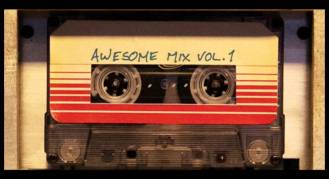
A clerical colleague, who has the advantage of having teenage children, explained to me that it all started with Guardians of the Galaxy. And I can see why. Rarely has anything been more aptly named than Awesome Mix Vol. 1. My coleague’s son had recently given his girlfriend a mixtape for her birthday – they use that ugly Americanism (ugh!) rather than ‘compilation’, apparently. A question formed in my mind: but surely he could just make her a playlist on Spotify? The answer was so obvious I never even uttered the words. A compilation would always be a physical token of their love – in a sense, a sacrament. An outward and visible sign of an inward and spiritual grace.
Maybe the young people aren’t so rum after all.
* * * * *
I understand the merits of online worship. I hear all the reports of bigger congregations, and the housebound being reconnected, and people too physically disabled to lead worship in the flesh finding themselves liberated by Zoom. I don’t decry it; long may it continue, after this horrible virus disappears into the history books. Praise be to God who reveals His wondrous work of human ingenuity in the worst of times.
But online worship just doesn’t work for me. As an easily distracted extrovert, I find it too easy to have another window or three open during it, surfing social media or working on some urgent task. That doesn’t present a very edifying picture of me, but I suspect I’m far from the only one. I would never normally pray at my work desk in any case; I go into the garden to say my Office, or sit in the living room bay window. Ideally, I would live next to the Church, and toddle inside to pray morning and evening, according to the Book of Common Prayer of course, close by the reserved Sacrament. I might even acquire a black Labrador to toddle in with me and complete a living fantasy part Ferrar and part All Gas and Gaiters. Straining to keep up with the times is vastly overrated – why would tapes be coming back in otherwise? I can’t help noticing that those of my colleagues most enthusiastic about online worship tend to be a little older, often working in communities that are a little older. That doesn’t surprise me. Even ageing Generation Xers like me take technology for granted; it has little wow factor. Getting excited about free multi-participant videoconferencing is, like, sooooo 2004.
Of course there is a place for both physical and online worship; this is the Church of England, after all. I could say that it isn’t a case of either the old ways or the new ways. “…every scribe which is instructed unto the kingdom of heaven is like unto a man that is an householder, which bringeth forth out of his treasure things new and old.” But being present, together, in the flesh, matters. Worship should engage all the senses, online worship only engages two, the visual and auditory senses which modern life almost certainly makes us all over-dependent on. More than that, it is worship in two-dimensions, and those enthusiastic for online worship must take care that it does not produce two-dimensional communities – with no depth, easy to puncture and easy to tear apart.
The Virtual Reality pioneer Jaron Lanier, who has long eschewed having social media accounts, recalls that already in the 1980s online communities were prone to fallings out, to huge rows breaking out over minutiae, to people being consumed by stupid arguments. In the days of smartphones the arguments follow us everywhere. It’s harder to hate a person who is sitting face-to-face with you, still less kneeling next to you at the altar rail; although, God knows, churchpeople have often enough made determined attempts at hating in those conditions. I worry that without careful attention we are going to blunder into dependence on a technology with a proven track record of making every well-known behaviour problem of Christian congregations much worse. That careful attention can and must be given, now, rather than doing as the social media magnates did and waiting until the damage becomes severe.
More than that, Christianity is a religion of the physical, worshipping Jesus Christ, the human being who was God and who lives in bread and wine; worshipping Jesus who was put to death by wood and nails which were absolutely physical, as physical as an intubation. Technology has not, in the end, “liberated” us from our physical forms, in all their joys, pains, and limitations. Christians are still called to meet together in person to break bread and share wine, with five senses and in three dimensions. If you think that doesn’t matter, ask teenagers why they’re making mixtapes and forking out hundreds of quid on eBay for a Sony Walkman that’s still serviceable.