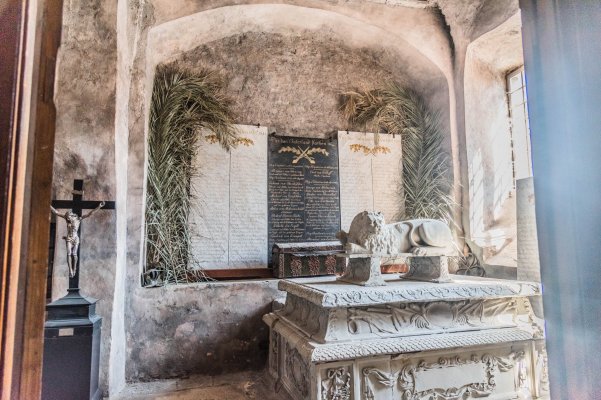
A Tallinn Memorial from the Days before Nationalism

Tallinn Memorial

In the Toomkirik, Tallinn’s Lutheran Cathedral, this memorial to those who “für das Vaterland starben [died for the Fatherland], 1812-14”.

In the wars against Napoleon, the ‘Vaterland’ the German-speaking Protestant élite of Estonia died for was the Empire of the Tsars.

200 years ago, nationalism and the nation-state were concepts only beginning to emerge. Due loyalty was assumed to be to one’s sovereign, not one’s ethnic kinsman.

Read more

Mariken van Nieumeghen aka Little Mary of Nijmegen

Stevenskerk-18.jpg

This bronze statue has been on Nijmegen’s Grote Markt, by the entrance to the Stevenskerk, since 1956 and was executed by Vera Tummers-Van Hasselt. It represents Mariken van Nieumeghen (Little Mary of Nijmegen) one of the symbols of the city in one of the best loved pieces of medieval Dutch literature.

According to a miracle play probably written between 1485 and 1510 in Antwerp, Mariken lived with the devil for seven years. Mariken had to go into town to do some shopping for her uncle. By the time she finished, it was already too late to go home, and she was not welcome to stay with her aunt in the city.

Wandering through the countryside, she met the Devil, who presents himself as Moenen. Moenen persuaded Mariken to accompany him to Antwerp. There, they led a very dissolute life for years. But Mariken wanted to see her family again. Together Mariken and Moenen returned to Nijmegen. Once there, Mariken sees a pageant, which demonstrates that everyone can receive forgiveness from God for their sins, which brings Mariken to repentance.

Read more

Buckfast Abbey

A meeting recently took me to Buckfast Abbey, a first visit. This is a Benedictine Abbey in the heart of rural Devon. It was a midwinter day of strong sunshine and stronger showers, which allowed for some dramatic photography.

Dating back to late Saxon times, Buckfast Abbey was suppressed by Henry VIII in 1539 (frankly, it was already quite decayed and the remaining monks accepted generous payments to repudiate their sacred vows and go quietly). In the early 1800s, almost all the buildings were demolished by a local landowner to make way for a large house. In 1882, some French Benedictines returned to re-establish a community there, which survives to this day.

They immediately built a temporary chapel (the grey buildings on the right) before the current main Abbey church was built, to a design by Frank Walters, from 1906-32, with the tower completed in 1938.Buckfast Abbey, South West Elevation

For me, the crowning glory is Dom Charles Norris’ stunning 1968 east window of Christ at the Last Supper in the 1965 Blessed Sacrament Chapel at Buckfast Abbey. Modernist and depicting a definitely post-Vatican II vision of Catholicism. Thick tiles of glass, chipped to shape and set in concrete or epoxy resin.

Read more

On The Twelfth Day of Christmas

I’m still wishing people a Merry Christmas, because it’s still Christmastide: today is the Twelfth Day of Christmas, and traditionalists will take their decorations down tonight. In fact, this year, most churches will have an unusual thirteenth day of Christmas. Rare indeed will be the place of worship that keeps the Feast of the Epiphany … Read more

Tides Also Come In

TIDES ALSO COME IN (A response to Arnold. And to Cupitt.) A stormy sea today. Grey rock pools catch a leaden sky In Lowry hues; not very far away Bangor’s a shade; the hills of Ireland peer, Like dragons’ silhouettes through wind-whipped spray. Come, take the salt air, walk while the wind’s high! Only, the … Read more

God in the West: the New Atheism and Its Discontents

My Address to the Bournemouth William Temple Association, 5th December 2016     

Thank you for inviting me to speak at a meeting of the William Temple Association. Temple has long been a man I have admired. Indeed, he is a man whose prayers I often ask for, particularly when I confront some problem of presenting the Christian faith publicly. His Christianity and the Social Order, about to have its 75th anniversary, posed questions once seemingly answered by the welfare state, but has become extraordinarily fresh and relevant again over the past generation as a result of the changes in work and welfare.

That’s a reminder, at the start of my talk, that history does not move in straight lines nor proceed to any inevitable destinations.

Just ten years ago New Atheism stood at the zenith of its influence. A lot has happened since, and indeed the talk I will give tonight is considerably different than that I might have written this time last year.

It is often said that there is no period in history more difficult to understand than the very recent past. With that in mind, let us strain our imaginations to take ourselves back to the distant days of the mid-2000s, when the world was a very different place.

The God Delusion

Few books have been launched at such a perfectly apposite moment as was Richard Dawkins’ The God Delusion in 2006.

Two scenes dominated the public conception of God in the 2000s: the collapsing twin towers of the World Trade Centre after Al-Qa’eda attacked them; and Bush and Blair praying together before launching a badly planned war against the wrong target. By 2006, that war had gone awry, and Iraq was in the midst of sectarian bloodletting that was killing tens of thousands.

Read more

In response to Owen Jones: In Defence of the Establishment of the Church of England

Owen Jones’ appeal for the separation of church and state showed a deep respect for Christianity in general and the Church of England in particular. But he failed to explain how and why disestablishment would be an improvement. Throughout the article, I only read one serious criticism of the status quo: that it is an ‘anachronism’.

Perhaps so – the relationship between Church and state in Britain is certainly illogical. The monarch swears in the Coronation Oath to maintain the “Protestant Reformed Religion established by law”, but Britain doesn’t have an established Church. England has one, and Scotland has a different one, more thoroughgoingly Protestant than the curious part-Catholic hybrid south of the border. No kirk celebrated Holy Week like we did at St Martin’s in Salisbury, with prostrations before the Blessed Sacrament and kissing of the cross. Wales, like Northern Ireland, gets by without an established church.

Indeed Northern Ireland argues against disestablishment as a means of promoting good relations between faith communities. The Church of Ireland was disestablished fifty years before Northern Ireland’s creation, and was in any case the minority Protestant tradition in the new state. That didn’t prevent a horrendous history of state-sanctioned anti-Catholic discrimination, nor a descent into thirty years of ethno-religious violence.

Read more