Saint Nicholas the Wonder Worker is the Orthodox cathedral in Białystok, and the seat of the Bishop of the Białystok-Gdańsk in Polish Autocephalous Orthodox Church. Białystok is the tenth largest city in Poland, and the largest in the north-east, which has a relatively large Orthodox population compared to most of this predominantly Roman Catholic country. … Read more
St Pancratius (de Pancratiuskerk) in the little Dutch market town of ‘s-Heerenberg (population 8,000) and literally a ten minute stroll from the German border.
At first blush – another pretty, ornate, but unexceptional post-Vatican I church in the south eastern Netherlands, a sign of a long suppressed community bursting into both prosperity and political power. Inevitably designed by the Albert Tepe, a prolific architect of Dutch neogothic… and then…
In the north aisle a unusual piece of stained glass catches the eye – is that a Gestapo man in stained glass?
Yes, it is. And so one learns of the story of Frs. Galama and van Rooijen, parish priest and curate respectively, arrested in 1941 after preaching against the Dutch Nazi Party, the NSB, who were deported to Dachau where both died in 1942. The scene of the Judas kiss immediately above makes clear the bitter but rarely mentioned memories of collaboration and betrayal that must have haunted communities like this for decades after the war.
St Nicolai’s Church in the town of Kalkar (115km north of Cologne, 150km SE of Amsterdam) on the German Lower Rhine –a wonderland of woodcarving from the late 15th and 16th Centuries, where a remarkable cast of woodcarvers found themselves with the patronage of wealthy religious brotherhoods. The most remarkable trio were Arndt van Zwolle, working at the end of the 15th Century, and later on Arnt van Tricht and Heinrich Douvermann.
I have not done this remarkable church justice: I needed both a tripod and time in this very dark building, neither of which I had. But I hope I will at least wet your appetite.
The story of St Nicolai’s probably began in 1230, but became really interesting after it was rebuilt after a devastating fire in 1409. The superstructure was substantially rebuilt into its current form by 1421, but it is the wonderful woodworking from the period around 1488-1560 that makes this perhaps the most celebrated church on the Lower Rhine.
The church has nine surviving woodcarved altars from a remarkable period of creativity between around 1488 and 1560. Five are at least partly visible in this shot. Nearest to camera are, left, the 1535 Trinity Altar, and, right, the 1541 St John’s Altar, both by the remarkable Arnt van Tricht. The central chandelier with the Virgin Mary took from 1508-41 to execute: van Tricht and Douverman were both among the artists who worked on this. The high altar dates to 1488-1500.
Arndt van Zwolle’s magnificent oak High Altar: begun in 1488, it was still incomplete at van Zwolle’s death, and finished by Jan van Halderen and Ludwig Juppe from 1498-1500. Worked in oak, it shows a multiplicity of scenes from the life of Christ crowned by the Calvary. There are a total of 208 figures carved. Behind it is the stained glass installed in the year 2000, the originals having been destroyed a long time in the passt. These were executed by Karl-Martin Hartmann, a physicist as well as an artist, using motifs like Feynman diagrams, galaxies, and spectroheliographs.
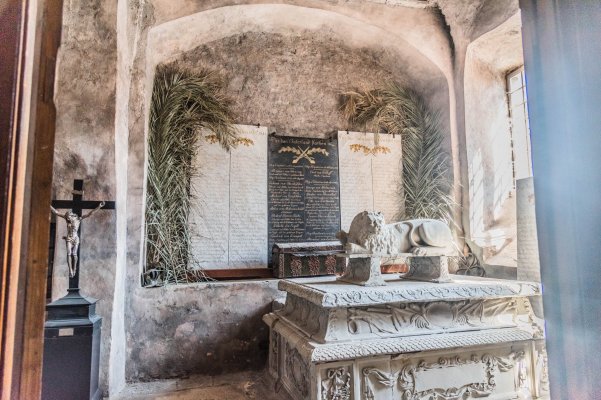
In the Toomkirik, Tallinn’s Lutheran Cathedral, this memorial to those who “für das Vaterland starben [died for the Fatherland], 1812-14”.
In the wars against Napoleon, the ‘Vaterland’ the German-speaking Protestant élite of Estonia died for was the Empire of the Tsars.
200 years ago, nationalism and the nation-state were concepts only beginning to emerge. Due loyalty was assumed to be to one’s sovereign, not one’s ethnic kinsman.
The last thing the disciples are recorded as saying to Christ on Earth: “Lord, is this the time when you will restore the kingdom to Israel?”
After all they’d been through, they still didn’t get the point. They were looking for an earthly realm founded on their values – which of course were God’s, and therefore would usher in an era of justice and peace – and missed so much about the Crucifixion and Resurrection they’d experienced first-hand. Doubtless too, they missed the subtle point that all earthly kingdoms, political, theological, or otherwise, are prone to corruption and subverting their own principles.
Why should we be surprised? After two thousand years, we are no different.
As a Liberal Catholic, I can understand Angela Tilby’s pain and sense of loss: for we were the future once. Our tribe had once controlled the kingdom – or at least that small part of it that is the Church of England – and, while we had our faults, it was broadly a time of enlightenment and faith, liberation and not a little courage. It is wonderfully captured in a photo from the mid-1980s, I think in Dean’s Yard, of a smiling Desmond Tutu and Robert Runcie. This was the future of the Church – Catholic and reformed, deeply faithful yet open to asking hard questions, confident in its calling while open towards others, sacrificially committed to justice and peace. This was just thirty years ago.