A Vision for the Appointed Time: Sermon Preached at St John’s, Devizes, Sunday 3rd July 2022 (Feast of St Thomas)

Readings – Habbakuk 2: 1–4; John 20: 24–29

“…there is a vision for the appointed time.”

It hasn’t been much of a summer, has it? Even by Wimbledon fortnight standards, we have had a depressingly heavy dose of rain. We are promised rather better for the next fortnight, and the wet start to the summer means we shall appreciate it all the more if we are indeed blessed with a fine spell in the next few weeks, when the days are still at their longest.

A carpet of flowers in the Namaqualand desert around a water-pumping mill.
The desert blooms briefly in South Africa’s Namaqualand region as winter ends. © Gerry Lynch 27 August 2011

On the other side of the world it isn’t high summer, but the depths of winter. In August, when winter starts to give way to springtime, something remarkable happens in the deserts that straddle the border between South Africa and Namibia. Normally almost completely barren, for a few weeks the desert blooms with carpets of flowers, sometimes stretching for miles in brilliant purples, oranges, and bright yellows, all giving off the most wonderful perfume. It is as if heaven has suddenly broken into the mundane world.

The same thing happens in a few other spots around the world as winter ends, where a desert approaches a western ocean coast and the rainfall patterns are favourable – in parts of Chile and California and Western Australia. The barren desert blooms with billions of wild flowers, and it comes and goes in a few weeks, and then the barrenness returns.

There is a vision for the appointed time… wait for it.

This is one of the more pessimistic times any of us have lived through. The desert has plenty of charms and compensations compared with the barren dryness of our culture and our political discourse.

It is not, despite all that, a time that quite matches the mood of hysterical doom-mongering that dominates our media reporting and especially our online discussions. I remember the 1980s, which were at least as politically divided as the current era, and also a time which in this country and generally in Western Europe was marked by much more politically-motivated violence than today, both in terms of terrorism and of street fighting. Most of it is now forgotten. The threat of war with Russia was quite a bit more intense then, with TV shows like Threads depicting the likely consequences of a nuclear war for ordinary people in grizzly detail. We also had a thousand miles of fortifications through the middle of Europe with easterners routinely shot dead by their own governments for trying to cross them. I am not going to join the panic-mongers just yet about our own situation, even if the United States seems to be in the grip of collective insanity.

Read more

The Gardener of Life: Sermon Preached at St Mary’s, Potterne, Sunday 17th April 2022 (Easter Day)

Readings – Acts 10: 34–43; John 20: 1–18

Supposing him to be the gardener, she said to him, ‘Sir, if you have carried him away, tell me where you have laid him…’

What a strange encounter between Mary Magdalene and Jesus in this morning’s Gospel. How could Mary possibly fail to recognise Jesus? She and Jesus were, after all, close – just two days before, on that terrible Friday, she had been one of the very last of Jesus’ disciples to be present at His crucifixion, when nearly all others had fled in fear. How could she of all people mistake Jesus for the gardener?

St Mary’s, Potterne – a lovely place to celebrate my first Easter Mass. © Gerry Lynch

Then we hear another odd phrase from Jesus’ lips when she might have been expected to hug Him: “Do not hold on to me, because I have not yet ascended to the Father.”

It is the first Easter morning, and Jesus is risen from the tomb! Alleluia! But something has changed. This is no mere resuscitation by a sort of divine defibrillator. Jesus is alive, speaking to Mary Magdalene, as they meet in the beauty of a garden on an early morning in the Jerusalem springtime. But she doesn’t recognise this intimate friend at first, and He asks her not to touch him. What is going on here?

Some of you may remember the Bishop of Durham back in the 1980s, David Jenkins, causing a bit of a flap by saying the Resurrection was no mere conjuring trick with bones. This was interpreted by the press to mean that the Resurrection wasn’t real. That wasn’t what Jenkins was saying at all, although I have to say as someone who used to be a bishop’s press officer that, for all his many virtues, Jenkins was his own worst enemy in dealing with the press.

Yet David Jenkins was absolutely right. The Resurrection is no “mere conjuring trick with bones”. It is something far greater than that. Heaven also isn’t simply an endless perfect day on earth, but a reality that is different, greater, than the one we experience in our physical bodies. In heaven we will be the human beings that God has created us to be, as individual and unique as all of us are, and yet also in harmony with one another, with God, and with the whole created order, in a way that simply cannot be in this world. Here death and sin have power over us; in heaven we will be liberated from them for eternity.

Read more

The Cost of Love: Sermon Preached at Holy Cross, Seend, Sunday 27th March 2022 (Mothering Sunday)

Readings – Colossians 3: 12–17; John 19: 25b–27

“…he said to his mother, ‘Woman, here is your son.’ Then he said to the disciple, ‘Here is your mother.’” 

Let me start this morning’s sermon with a verse of poetry:

Morning glory, starlit sky,
soaring music, scholar’s truth,
flight of swallows, autumn leaves,
memory’s treasure, grace of youth.

So begins the greatest poem of Bill Vanstone, seen by many as the most impressive Anglican thinker and theologian of the latter part of the Twentieth Century. At this time of year, with the weather magnificent and the air full of the scents and new life of spring, even in times as troubled as those we are in, one can be enraptured by this sort of mood, simply by being alive. It feels like heaven! Perhaps indeed it is an intimation of heaven.

A beautiful morning for another away match at Holy Cross, Seend. © Gerry Lynch

Of course, even in our brightest moments, that is never the whole story. Many of us will come here this morning with serious problems of our own; even those of us fortunate enough not to be in that position will be deeply worried about serious problems faced by people we love.

Love is the greatest gift given to any of us by God. It is the most wonderful and miraculous and life-giving thing about being human. Yet it also has a tremendous cost. It opens us up to feeling the pains of the people we love.  The second stanza of Vanstone’s poem is clear about that cost, as it continues:

Open are the gifts of God,
gifts of love to mind and sense;
hidden is love’s agony,
love’s endeavour, love’s expense.

Some people seem to think that even to celebrate this Sunday as Mother’s Day is somehow excluding and potentially wounding for those without children or whose relationships with their mothers were difficult. Well, as a childless, single man, let me say that it is simply an obvious statement of fact that mothers have a particular and unique relationship with the children they have born in their womb, an intensely physical connection that no male can ever have. Mothers perhaps more than any of us know just how costly and agonising love can be.

Read more

Crumbling Empires and Eternal Bliss: Sermon Preached at St John’s, Devizes, Sunday 21st November 2021 (Christ the King)

Remnants of a vanished empire: a Soviet red star from 1953 on Kyiv's Paton Bridge.

Readings – Revelation 1:4b-8; Mark 10:17–31

 “My Kingdom is not from of this world.” 

May I speak in the name of God who is Father, Son, and Holy Spirit. Amen.

Some of you know, and some of you don’t, that I am a very keen radio ham, and a particular enthusiast for Morse code, which is still in use by hobbyists around the world on a daily basis. My love affair with radio started when I was an eight year old boy, on discovering that the radio cassette player my parents had given me as a Christmas present had a switch marked “Short Wave”. At first, tuning the dial on this strange waveband was unpropitious, as the adults had all assured me would be the case, revealing only strange bleeps and noises and a few stations in languages I didn’t even recognise.

Remnants of a vanished empire: a Soviet red star from 1953 on Kyiv's Paton Bridge.
Remnants of a vanished empire: a Soviet red star from 1953 on Kyiv’s Paton Bridge, 11 August 2017, © Gerry Lynch.

Within a few hours, however, I had discovered programmes in immaculate English from Sweden, the Netherlands, and Czechoslovakia and things developed from there over the following weeks and months. To a child always fascinated by maps and already at that tender age becoming interested in politics, that cassette player became like a magic carpet to distant lands, so much more remote in those pre-Internet days of the 1980s.

One of the most ubiquitous stations, and certainly the most bizarre, was Radio Tirana, which dominated large parts of the Short Wave spectrum with its creepy and unforgettable theme tune, introducing broadcasts that promoted Albania’s official state ideology in every language from Armenian to Zulu. It seemed to despise equally both what it described as American Imperialists and Soviet Socialist Imperialists, but its real ire was reserved for the oul’ enemy – the imperialists of Yugoslavia.

The undoubted king of the dial, however, was Radio Moscow, which in English alone had not only a North American service, and a World Service aimed mainly at audiences in Africa and South Asia, but for an hour at 8 o’clock every evening the wonderful Britain and Ireland Service. It was presented by gentlemen who were very well-spoken indeed, sounding like they had been educated at Marlborough and Cambridge – because they probably had been. They presented the failures of the Soviet Union as being the inevitable flaws of a system that was still merely Socialist, and that these would ultimately disappear as a perfect political system, a genuine Communism, inevitably emerged.

I discovered all this at Christmas 1985. Within a few years, Czechoslovakia, Yugoslavia, and even the mighty Soviet Union all vanished from our maps. Empires rise and fall. They always have done and always will do, and they are always profoundly flawed entities.

Read more

Ecclesiastical History Rocks: 1960s Pentecostalism and Nigerian Anglicans

I spotted this interesting article and follow up letter in the Church Times when exploring its coverage of the 1968 Lambeth Conference. The article notes that the number of Anglicans in “the western part of Nigeria” was declining in favour of Pentecostals. Nigerian Anglicanism had gone through phases of shedding both sects and adherents towards Independency since at least the 1920s. But this was possibly the first report in the press of a new phenomenon which would have significant impacts on Anglicanism across the world.

There was a major Third Wave of new Pentecostal Churches emergent in Africa from the mid-1970s; in Nigeria, the continent’s most populous country, Jesse Zink locates this surge as beginning a little earlier, with an evangelical revival during the civil war of 1967-70. It would be incubated and then enormously multiplied in student groups meeting in the margins of the expanding Nigerian university system of the 1970s. Matthews Ojo understands these African movements as originating in the 1960s Pentecostalist revivals in North America and Britain; but Nigerian Independency long had links with the Anglo-Saxon north, and the influence wasn’t always unidirectional either.

Also of note here is some indirect evidence of Muslim-to-Christian conversion in Nigeria, which is far from unknown but somehow seems to escape everyone’s notice.

Anglicans facing competition from the burgeoning Pentecostal scene in Africa was one of a complex cluster of reasons why the issue of homosexuality became so toxic within world Anglicanism from the mid-1990s onwards.


From the Church Times, 9 August 1968

Fewer Anglicans in W. Nigeria

The number of Anglicans in the western part of Nigeria, West Africa, is declining, to the benefit of other denominations.

This is revealed in the report published giving the results of a research project into the “Role of Religion in Yoruba Society,” conducted by the Institute of African Studies of the University of Ife, Nigeria.

Read more

A Clergyman’s Diary: A Wiltshire Transfiguration

The Wansdyke near Baltic Farm, 10 October 2021. © Gerry Lynch.

Nobody is quite sure when the Wansdyke was built, but the most commonly advanced theory is that it was built by the Romano-British after they were abandoned by the Imperial power to defend their stronghold in what is now Gloucestershire, Somerset, and northern Wiltshire, in the face of Saxon expansion spreading northwards from the English Channel. This would date it to around the end of the 5th Century. Regardless of exactly at which point in the transition from Roman Britain to Anglo-Saxon England it was built, it seems that the much later Anglo-Saxons had lost any idea about its purpose when, despite several centuries of Christianity, they named it Woden’s Dyke, after Odin, the king of the Norse gods, around the 9th Century.

The eastern section, in Wiltshire, has been much less disturbed over the centuries by agriculture and building than those further west, and this section, north of the village of Bishops Cannings, is particularly dramatic when lit by low late afternoon sun from the south in autumn and winter.

On a rainy day in midwinter, with the rain belting down for weeks, it can be a little disappointing, a flat bank of mud surrounded by dirty puddles. Yet the sun can transfigure it into mysterious magnificence in all seasons, always easy on the ankles, even for someone with my short legs and my fat belly. The ground remains springy and fast when in a hot dry spell when the surrounding terrain is drained and hard; and also when it is surrounded by wet muck.

Looking east from Morgan’s Hill towards Tan Hill, the Wansdyke just visible in the bottom of the valley, 10 October 2021. © Gerry Lynch.

It is as much as 4 metres high in places. It is followed by a long-distance footpath for all of this stretch. The view in the distance reaches to Tan Hill, at 294 metres above sea level the joint highest point in Wiltshire.

This is deep England. The countryside is not especially dramatic but rolls with a heart-healing, gentle, beauty. I walk here regularly, with various circuits of 12-18 miles (19-30 km) starting and finishing from my home in Devizes taking in stretches of it. When the light is like this, it makes my soul sing and fills me with gratitude for being alive.

Read more

A Soldier Shot on the Afghan Frontier, 1889

In Rochester Cathedral, a cross executed in memory of Lt Archie Harris of the Royal Engineers “[s]hot while in pursuit of a Pathan robber on the Afghan frontier”, 11 October 1889. History doesn’t repeat but it does rhyme. “A scrimmage in a Border Station-A canter down some dark defileTwo thousand pounds of educationDrops to a … Read more

Afghanistan Exposes the West’s Crisis as it did the Soviets’

This post originally appeared on Slugger O’Toole

The Soviet Empire was undone by three things – firstly, overstretching itself, especially through the acquisition of a series of Global South satrapies from Nicaragua through Ethiopia to Vietnam in the 1970s and 1980s; secondly, misrepresenting realities to itself so as to fit Marxist-Leninist orthodoxy; thirdly, because its leaders no longer believed in that political religion even as they presided over a system that permitted no alternative.

Mohammad Najibullah’s government hung on in Kabul for three years after Soviet troops were withdrawn from Afghanistan in 1989; Ashraf Ghani’s kleptostate didn’t even survive until America’s withdrawal date. US and other Western experts were more wrong about Afghan society than the famously self-deluding late Soviet Union; in terms of plain logistics, the US executed a shockingly less competent withdrawal than a USSR on the brink of collapse; and in the shape of Ghani and before him Karzai, it backed rulers so monumentally corrupt that they seem to have been less palatable to devout Afghan Muslims than actual godless Communists.

In the dying days of 1979, Yuri Andropov, then head of the KGB, fought an initially successful internal battle against Soviet intervention in the country after the Communist coup, convinced that invading Afghanistan would end up in failure; it was feuding between Afghan Communist factions once in power that dragged the USSR in, and fear of losing face in the propaganda game of the late Cold War that kept it there for a while. But it only took the Soviets seven years to realise they weren’t actually being welcomed as defenders of material progress and women’s rights against religious obscurantism, and they were gone in nine. America took twenty.

Soviet APCs depart Afghanistan as part of the first phase of troop withdrawal in 1986.
Soviet APCs depart Afghanistan as part of the first phase of troop withdrawal in 1986. © RIA Novosti archive/ Yuriy Somov. Used under CC-BY-SA 3.0.

Yet all the while, the people directing the war in DC knew it was going badly and simply lied, as the Washington Post exposed in 2019 when it got access to the US government’s own report on its failures in Afghanistan. The Bush, Obama, and Trump administrations all lied, knowingly, not just to the public but much of the time to themselves; they couldn’t have sustained this war for 20 years otherwise. Countless experts colluded in the lies, spending time and money to create analyses to fit a consciously deceitful official narrative, nodding along because dissenting voices find their careers limited while nodding dogs get to bill four-figure daily rates.

Governments lying to themselves with the encouragement of experts well-paid to silence truth-tellers is a pattern of behaviour familiar from the story of toxic mortgage bonds and the 2008 financial crisis; something similar will probably turn out to surround the pandemic’s origins and how influential Western medics helped Beijing cover them up. This is not just an American problem. Lying is just as embedded, for example, in the UK, where the political class and punditocracy spent yesterday arguing about the ways in which Britain could have saved Kabul from the Taliban when the same people know British combat troops left Afghanistan in 2014.

Truth is now entirely subject to political ideology in the West, but being liberal democracies rather than a single-ideology state, various nexuses of deceit sell different sets of lies to their own groups of followers. The progressive/left take is that jihadism only exists because of colonialism and White supremacy with British Labour MP Richard Burgon even demanding reparations be paid to the Taliban. The soi disant sensible centre-left-to-mainstream-right were the actual architects of the Afghan disaster, with neocons and hawkish liberals like Blair inventing for themselves an Islamic world crying out to be bombed from the air so they could be free. And, of course, the post-Trump GOP is so far down the rabbit-hole of QAnon-lizardmen-paedo-pizza conspiracy that it doesn’t worry that its lies sound like they come from the secure wing of the local asylum.

Read more

“Rebuild my Church”: Sermon Preached at St John’s Devizes on Sunday 4 October 2020 (the 17th Sunday After Trinity) by Gerry Lynch

Readings – Philippians 3:4b-14, Matthew 21:33-46

I press on towards the goal for the prize of the heavenly call of God in Christ Jesus.

May I speak in the name of God, who is Father, Son, and Holy Spirit. Amen.

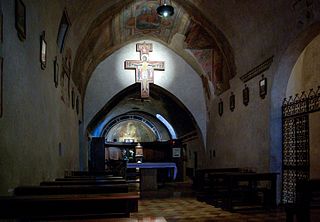
The Church of St Damian, Assisi. Photo credit Berthold Werner.

It is a time of troubles. Plagues, accelerated by the rapid growth in intercontinental trade, spread across the world with dizzying speed. The economic gap between rich and poor is yawning, and many of the young have given up on the ability of the existing order to usher in a just society and are seeking a completely fresh start, consigning the old ways to the dustbin of history with as much aggression as needed. The West and the Islamic world are at loggerheads, with Western powers embroiled in multiple bloody conflicts in the Middle East, which started so long ago that nobody much remembers how or why they started. I am not, of course, talking about the present day but about the first years of the 13th Century, a time when the older townsfolk of Devizes will still have remembered the Church of St John the Baptist being built. There is truly nothing new under the Sun. 

In that tumultuous time, a rich young party animal called Francis, whose feast we commemorate today, was having a life crisis. Set to inherit a family fortune, he had spent his youth hanging out with the troubadours, the wandering bands of minstrels who travelled around during the High Middle Ages making music, singing with them in his beautiful voice and partying with them. An attempt to settle down a little by turning his hand to soldiering had resulted in Francis spending a year as a prisoner of war. After that, his former life of drinking and dancing no longer had any appeal. He wandered the countryside of his native central Italy, half-starved and dressed in rags, begging God to show him a more meaningful way of life. One day, Francis stumbled across a church dedicated to Saint Damian, no older than the then relatively new St John’s, but already falling into disrepair. Amid the crumbling stones, he had a vision of an Icon of Christ Crucified that hung in the church speaking to him. “Rebuild my Church”, it said.

He took up the task with enthusiasm, starting with the physical rebuilding of that Church of St Damian, and going on to work for a spiritual renovation of the whole Christian world. Some of his schemes were perhaps a little overambitious: he once travelled to Cairo, reckoning that if he could only convert the Sultan to Christianity then he could end the wars connected to the Crusades. You will not be surprised to learn that he wasn’t successful.

But that isn’t the point – the point is that he gave things a go. Following Christ isn’t about following a series of step-by-step orders like the instructions for setting up a new mobile phone. As we know, that doesn’t guarantee success anyway. Richard Holloway once described the Christian journey as being less like marching to a heavenly military band and more like joining God in a jazz jam session, listening to the music God is playing and seeking to chime our own personal riffs with His. Christian obedience is about co-operating with God and recognising our own immense value to Him. God is not a cosmic sergeant-major waiting to scream at us angrily if we miss a beat. If God doesn’t pick up on the tune we’re playing, we can always get back into the beat in the next bar. New life can begin at any time. Following Christ is about trying to sense where the Holy Spirit is leading, trying different ideas, accepting that God will not pick up on some of them, because it’s only in a world of chance and risk and serendipity that other little tunes we toot can blossom into symphonies that are more magnificent than anything we could have imagined.

Read more

The Mosque of Bohoniki

The Mosque of Bohoniki, South West ElevationThe mosque at Bohoniki is one of the last places of worship of the Lipka Tatar community which still survives as it has since the late 14th Century in what are now the borderlands Poland, Lithuania, and Belarus.

The mosque was built at the turn of the 19th and the 20th centuries, probably in 1873 to replace an earlier mosque destroyed in a fire. During World War II, the mosque was destroyed by the Nazis, who organised a field hospital on the site. After 1945, the mosque underwent several renovations several times. In 2003, the roof was renovated; the tin roof was changed to shingle roof. In 2005 a general renovation was carried out.

It is a simple wooden building built on a rectangular plan with dimensions of 11.49 m × 8.03 m. It has been restored with the help of the Polish and Turkish governments and the European Union.

Bohoniki Mosque - Minbar

This is the minbar, a pulpit in any mosque, where the imam stands to deliver sermons, as well as delivering a wider range of readings and prayers.

Read more