Vilnius Cathedral

The Cathedral Basilica of St Stanislaus and St Ladislaus of Vilnius (Lithuanian: Vilniaus Šv. Stanislovo ir Šv. Vladislovo arkikatedra bazilika) is the Roman Catholic mother church of Lithuania.   The coronations of the Grand Dukes of Lithuania took place within its confines. Many famous people from Lithuanian and Polish history are buried there During the … Read more

Cathedral of St Nicholas the Wonder Worker, Białystok

Saint Nicholas the Wonder Worker is the Orthodox cathedral in Białystok, and the seat of the Bishop of the Białystok-Gdańsk in Polish Autocephalous Orthodox Church. Białystok is the tenth largest city in Poland, and the largest in the north-east, which has a relatively large Orthodox population compared to most of this predominantly Roman Catholic country. … Read more

Holy Cross Church, Vilnius

The history of the little church of Holy Cross, Vilnius, dates back to 1543, when a chapel was built on the site to commemorate the martyrdom of a group of Franscians in the 14th Century. In the 16th century, a Gothic chapel of the Holy Cross was built here by the Bishop of Vilnius Povilas … Read more

The Bright Field

Late on a summer evening, as I took photos from the summit of Divis (478m above sea level) the highest of the Belfast Hills towards Lough Neagh, suddenly a shaft of sunlight broke through and illuminated the fields on top of Budore Hill, about 4 km away. Clearly visible on Lough Neagh is Ram’s Island, … Read more

Blogging Staggers Day One: Praying With the Lepers

The Bartlemas Chapel – a name that sounds like something out of Dickens, and the chapel felt like something from a disappeared world as well. A few hundred metres down a laneway from the noise and bustle of the Cowley Road lies a former leper chapel, feeling as if it were behind a portal to … Read more

St Aldegundis, Emmerich

St Aldegundis, Emmerich, North Elevation

Difficult to photograph close in due to its dense inner-city site, some say that St Aldegundis is on the site of the original mission church in what later became Emmerich am Rhein, founded by St Wilibrord around 700. That is debatable, but what is certain was there was a collegiate foundation in the town by 914 and that a church on this site burnt down in the early 15th Century. The current building was built to replace it between 1449 and 1514.

It has many lovely late medieval statues, photographed and described below…

Read more

St Pancratius, ‘s-Heerenberg, and the ‘Gestapo Window’

St Pancratius, 's-Heerenberg, North Elevation

St Pancratius (de Pancratiuskerk) in the little Dutch market town of ‘s-Heerenberg (population 8,000) and literally a ten minute stroll from the German border.

At first blush – another pretty, ornate, but unexceptional post-Vatican I church in the south eastern Netherlands, a sign of a long suppressed community bursting into both prosperity and political power. Inevitably designed by the Albert Tepe, a prolific architect of Dutch neogothic… and then…

In the north aisle a unusual piece of stained glass catches the eye – is that a Gestapo man in stained glass?

St Pancratius, 's-Heerenberg, Close Up of ‘Gestapo Window’

Yes, it is. And so one learns of the story of Frs. Galama and van Rooijen, parish priest and curate respectively, arrested in 1941 after preaching against the Dutch Nazi Party, the NSB, who were deported to Dachau where both died in 1942. The scene of the Judas kiss immediately above makes clear the bitter but rarely mentioned memories of collaboration and betrayal that must have haunted communities like this for decades after the war.

Read more

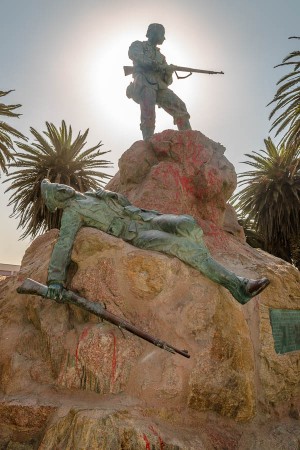
What Is A Man? The Question Asked by a Memorial to Forgotten Wars

The memorial to the fallen of the 1860s Wars of German Unification in the Rheinpark in Emmerich (Kriegerdenkmal, Emmerich). Emmerich is a sleepy little river port on the Rhine, literally within a casual afternoon stroll of the Dutch border.


Emmericher Kriegerdenkmal.jpg

Completed under Wilhelm Kreis in 1913 on the eve of the First World War and deeply redolent of the ‘dulce et decorum est’ mentality which played such a role in that conflagration.

Upper text: “Der ist ein Mann, der sterben kann für Gott und Vaterland. EM Arndt.” – He is a man, who can die for God and fatherland.

Read more

The Opioids of the People

Crossposted at Slugger O’Toole…

The United States government has launched a new anti-opioid campaign featuring true stories of people so desperate that they inflicted gruesome injuries on themselves to get another prescription.

Such stories have already been more effectively told in poetry. The epidemic’s most searing skald is William Brewer, a son of Oceana, West Virginia, a post-industrial town so gripped by addiction that it is nicknamed Oxyana.

We were so hungry; Tom’s hand
on the table looked like warm bread.
I crushed it with a hammer
then walked him to the ER to score pills.

The United States has now experienced its second consecutive year of declining life expectancy. A significant part of the change is driven by what have been called ‘deaths of despair’ among middle aged White people: as well as drugs, alcohol and suicide are also spiralling. Death rates among White Americans aged 45-54 increased by 0.5% per year between 1999 and 2013, and there is no sign the trend has reversed since. While the death of celebrity chef Anthony Bourdain this weekhas brought fresh awareness of suicide, rates have been rising for years, especially among middle-aged men, and are now 25% higher than they were at the turn of the millennium.

Read more